
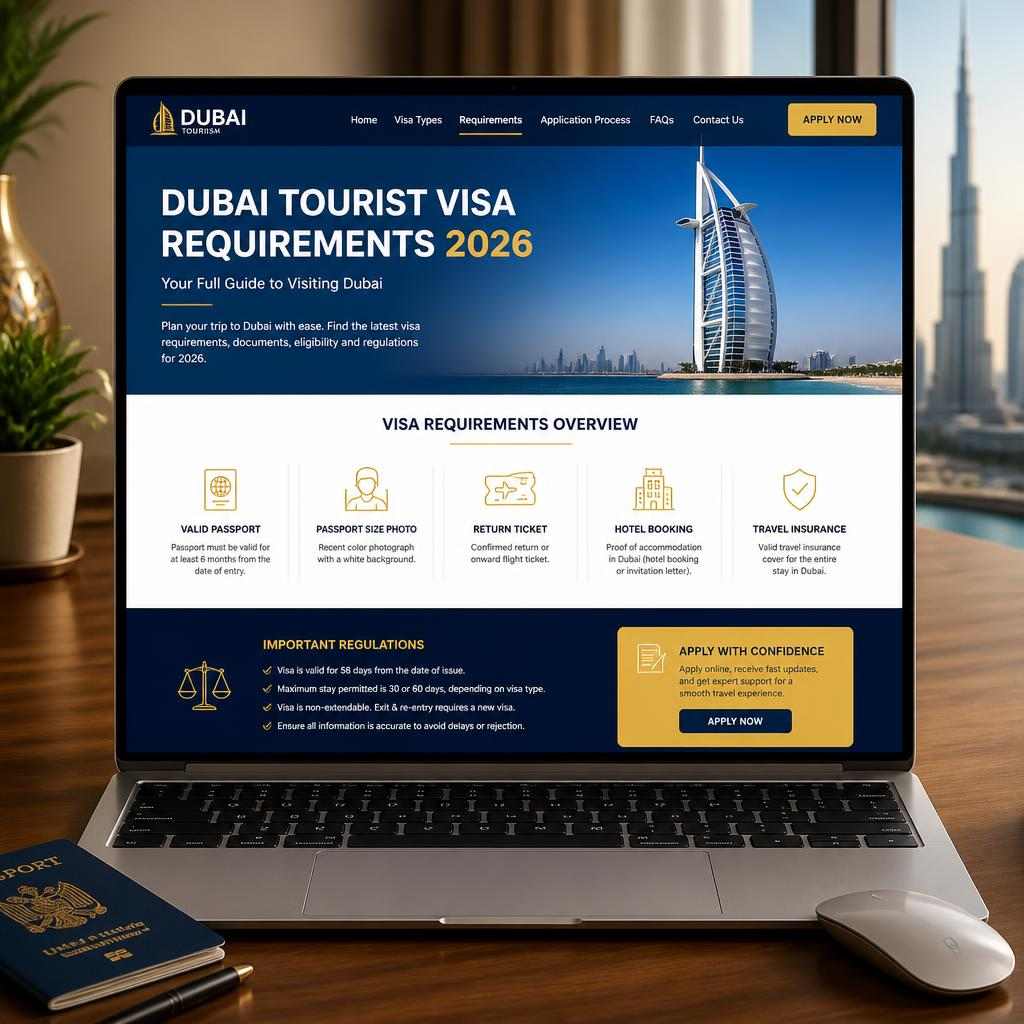
You’ve decided to visit Dubai. Now you need a visa — and the moment you search for requirements, you land on pages that either list vague generalities or mix up 2024 rules with 2026 ones. That’s a problem when UAE immigration policies have changed significantly since early 2026. The overstay grace period is gone. A 5-year multi-entry tourist visa now exists. Photo requirements are stricter than they’ve ever been. And the cost breakdown that most pages show you is incomplete by at least two or three line items.
Here’s the clear version. Every Dubai tourist visa requirement covered below reflects current ICP and GDRFA guidelines as of June 2026. If you’re applying through a licensed travel agency like AlNomadi Tourism, most of this process is handled for you — but understanding it yourself means you don’t show up with the wrong documents.
Who Needs a Dubai Tourist Visa — and Who Doesn’t
Not everyone needs to apply. The answer depends entirely on your passport.
Visa-free on arrival (30 days): Citizens of over 100 countries including the UK, USA, Canada, Australia, most EU nations, Japan, South Korea, New Zealand, and Singapore receive a free 30-day stamp on arrival at Dubai International Airport (DXB). No application required. No fee. Your passport is stamped at immigration.
Extended visa on arrival (90 days, multiple entry): Passport holders from select countries — including most Western European nations and several GCC-linked nationalities — receive a 90-day multiple-entry visa on arrival, valid for 6 months from issue, capped at 90 days of total stay.
Indian nationals (14-day on-arrival, from January 2024): Eligible Indian nationals with a valid US visa, UK visa, EU residence permit, or residence issued by Australia, Canada, Japan, New Zealand, South Korea, or Singapore can receive a 14-day single-entry visa on arrival at a fee of USD 63. This rule remains active in 2026.
Pre-approval required: Nationals from South Asia (Pakistan, Bangladesh, Nepal, Sri Lanka), most African countries, Central Asia, and parts of the Middle East must obtain a Dubai tourist visa before travel through a licensed sponsor — an airline, hotel, or DTCM-licensed travel agency.
If you’re unsure where your passport sits, the fastest check is the ICP Smart Services portal at smartservices.icp.gov.ae. AlNomadi Tourism also runs a fast eligibility check — contact the team at +971-56-7803835 before booking anything.
Dubai Tourist Visa Requirements: The Complete Documents List
Meeting the Dubai tourist visa requirements for 2026 means getting every document right before submission — not after. Errors and omissions are the leading cause of delays and rejections.
Standard Documents for All Applicants
- ☐ Passport copy — colour scan, full clarity, minimum 6 months validity from the date of travel (not the application date)
- ☐ Passport photograph — white background only, natural expression, recent (taken within 3 months), no glasses, no filters. More applications are rejected for photo quality than for any other reason.
- ☐ Completed visa application form — all details must match the passport exactly. Even a middle name discrepancy causes rejection.
- ☐ Confirmed return or onward flight ticket — must show exit from the UAE within the visa validity period
- ☐ Hotel booking or accommodation proof — confirmed reservation or a host’s invitation letter if staying with a UAE resident
- ☐ Travel insurance — basic medical cover valid for the UAE (from AED 40 for a 30-day policy)
- ☐ Bank statement (last 3–6 months) — evidence of sufficient funds; for the 5-year multi-entry tourist visa, a minimum balance of USD 4,000 (approximately AED 14,700) is required, introduced in 2026
Additional Requirements by Nationality
Applicants from Pakistan, Afghanistan, Iran, and Iraq must additionally provide a national identity card copy alongside the passport. This is a GDRFA-specific requirement and is often missed by first-time applicants from these countries.
For minors (children under 18) travelling with only one parent: a notarised NOC (No Objection Certificate) from the absent parent is required. For children travelling with neither parent, a notarised letter of guardianship plus proof of the guardian’s UAE residency must be submitted.
As of 2026, GDRFA has introduced an additional verification step for some nationalities: applicants may be asked to provide a scan of the passport’s outer cover page as an extra identity check layer. Not all agencies flag this — it’s worth including proactively.
Dubai Tourist Visa Types and Costs in 2026
Dubai tourist visa is a broad term covering several distinct categories. Choosing the wrong one costs either money (if you end up needing an extension) or time (if you apply for a category you don’t qualify for).
| Visa Type | Duration | Entry | Government Fee | Total Cost (est.) | Best For |
|---|---|---|---|---|---|
| Single-Entry Tourist | 30 days | Once | AED 252 | AED 400–600 | Standard holidays, short visits |
| Single-Entry Tourist | 60 days | Once | AED 352 | AED 600–900 | Extended travel, family visits |
| Multiple-Entry Tourist | 30 days | Unlimited in period | Higher | AED 700–1,000 | Regional business, GCC travel |
| Multiple-Entry Tourist | 60 days | Unlimited in period | Higher | AED 900–1,200 | Frequent short visits |
| 5-Year Multi-Entry Tourist | 90 days/visit, 180 days/year | Unlimited | AED 1,000–1,200 | AED 1,800–2,500 + AED 3,000 refundable deposit | Frequent visitors, long-term tourism |
| Transit Visa (48hr) | 48 hours | Once | Free | AED 0–50 | Layovers |
| Transit Visa (96hr) | 96 hours | Once | AED 50 | AED 50–100 | Extended layovers |
(Government fees from GDRFA official service catalogue. Total cost estimates include 5% VAT, service charges, and basic insurance. Verify current fees with your visa provider or at gdrfad.gov.ae before applying. Fees are subject to change.)
A few cost realities worth knowing: applying from inside the UAE (Change of Status) adds AED 500 + AED 10 Knowledge Dirham + AED 10 Innovation Dirham on top of standard fees. Express processing (24–48 hours) adds AED 200–500. The 5-year visa’s AED 3,000 security deposit is refundable once the visa expires or is cancelled — but the refund process takes time and requires you to meet all immigration compliance conditions.
Dubai Tourist Visa Age Requirements
Dubai doesn’t have a universal minimum age for tourist visa applications — but age affects the process in several specific ways worth understanding.
Children and Minors
Children under 18 require a visa in their own name. Their application must be sponsored alongside a parent or legal guardian. When a child travels with both parents, standard documents apply. When travelling with one parent, a notarised No Objection Certificate from the absent parent — preferably attested — reduces the risk of being questioned at immigration.
Unaccompanied minors — children travelling without a parent or guardian — cannot apply for most tourist visa categories and face specific restrictions at UAE airports. Airlines typically require written parental consent and airline-specific documentation for unaccompanied minors regardless of visa status.
Older Travellers
There’s no upper age restriction for a Dubai tourist visa. Senior travellers (typically defined as 60+ in UAE immigration contexts) follow the same process as other adult applicants. The only age-specific consideration is that parents over 60 years of age who are dependents of UAE residents may be eligible for a resident-sponsored visit visa rather than a self-sponsored tourist visa — a route that comes with different documentation requirements.
The New 2026 Rules You Can’t Afford to Miss
Several meaningful changes to Dubai’s visa system took effect in early 2026. Most competitor content doesn’t yet reflect all of them accurately.
1. Zero grace period for overstays (from 11 February 2026) The previous 10-day grace period after visa expiry has been permanently removed. Overstay fines now accrue from Day 1 at AED 50 per day, unified across all emirates and all visa types (tourist, visit, and residence). There is no warning window. If your 30-day visa expires on June 30, you owe AED 50 starting July 1. This applies to tourist visas, visit visas, and residence permits equally.
This is the single biggest practical change of 2026 for tourists. Plan your exit or extension well in advance.
2. The 5-year multi-entry tourist visa is now real and accessible The UAE launched a 5-year multiple-entry tourist visa available to all nationalities. Each stay can be up to 90 days, with a maximum of 180 days in any calendar year. No UAE sponsor is required — it’s self-sponsored. The catch: you need the USD 4,000 bank balance evidence and must pay a refundable AED 3,000 security deposit. For frequent visitors to Dubai, this visa eliminates the cost and friction of repeated 30/60-day applications.
3. Stricter photo and document standards GDRFA and ICP have tightened documentation standards in 2026. Passport clarity requirements are stricter. The additional passport cover scan requirement is being applied selectively but increasingly. Photo rejections have increased — the advice to not use smartphone filters or printed photos from non-licensed photo services is now a functional requirement, not a suggestion.
4. In-country extension now possible without exit A 2026 rule update allows tourist visa extension inside the UAE without requiring the holder to leave the country first. Each extension adds 30 days, with a maximum of two extensions (60 additional days total). Extension fees: AED 630 if applied from outside the UAE, or AED 1,130 if applied from inside the UAE after arrival. Apply through ICP Smart Services or at an Amer centre in Dubai before the current visa expires. There is no extension after expiry — you go straight to overstay fines.
The 30-Day Wait Rule: What Most Articles Ignore
If you exit the UAE after a standard 30-day tourist visa and want to re-enter on another 30-day tourist visa, UAE immigration applies an informal 30-day wait rule between stays. This isn’t a written law — it’s an immigration judgement call — but frequent re-entry on back-to-back short-stay visas raises a flag. Travellers attempting to live in the UAE on rolling tourist visas risk being questioned or denied entry on their second or third attempt.
If your situation involves regular long-term stays in Dubai without formal residency, the 5-year multi-entry tourist visa is the solution that immigration accepts. It’s designed for exactly this pattern and removes the re-entry risk.
How AlNomadi Tourism Handles Dubai Tourist Visa Applications
Applying through a DTCM-licensed travel agency like AlNomadi Tourism is the fastest route for nationalities that require pre-approval. The agency acts as your sponsor and submits directly through GDRFA or ICP systems, handling document verification, submission, follow-up, and delivery of the e-visa to your email.
Standard processing through AlNomadi takes 2–4 working days for a tourist visa. Express 24–48-hour processing is available at an additional charge. The team reviews your documents before submission — which is the step that eliminates rejections caused by photo quality issues, form mismatches, or missing national ID copies.
To start your application or check eligibility based on your nationality, contact AlNomadi at +971-56-7803835 or info@alnomadi.com. Bring your passport details and travel dates — the team will confirm which visa category fits your situation and what documents you need specifically.
Conclusion
Dubai’s tourist visa system in 2026 is more structured and more consequential than it’s been in previous years. The removal of the overstay grace period is not a minor update — it’s a hard shift that costs real money if you misjudge your departure date. The new 5-year visa is a genuine benefit for frequent visitors willing to meet the financial proof requirement. And the documentation standards are tighter, particularly around photographs and passport clarity.
Meeting the Dubai tourist visa requirements correctly the first time means no delays, no re-submissions, and no fines. The documents list, the right visa category for your travel duration, and the current cost structure are all covered above.
AlNomadi Tourism handles applications for all nationalities, with GDRFA-licensed direct submission, document review, and 24/7 contact support. Reach the team at +971-56-7803835 or visit alnomadi.com to begin.
Your Dubai trip starts with the visa — get it right once and travel without the stress.
FAQ SECTION
1. What are the basic Dubai tourist visa requirements in 2026? You need a valid passport with 6+ months remaining, a white-background photograph, a completed application form, return flight proof, and accommodation confirmation. Some nationalities also need a national ID copy and bank statements.
2. How much does a Dubai tourist visa cost in 2026? A 30-day single-entry tourist visa costs AED 400–600 total (including government fee of AED 252, VAT, service, and insurance). A 60-day visa runs AED 600–900. The 5-year multi-entry visa costs AED 1,800–2,500 plus a refundable AED 3,000 security deposit.
3. Is there a minimum age requirement for a Dubai tourist visa? No minimum age — children can be sponsored on their own visa. Minors under 18 travelling with only one parent need a notarised NOC from the absent parent, and unaccompanied minors face strict airline and immigration restrictions.
4. What happens if my Dubai tourist visa expires and I haven’t left? As of 11 February 2026, there is no grace period. Overstay fines of AED 50 per day apply from Day 1 after expiry. You must either exit the UAE or apply for an extension before your visa expires — not after.
5. Can I extend a Dubai tourist visa without leaving the UAE? Yes — as of 2026, you can extend inside the UAE. Each extension adds 30 days (maximum two extensions). Cost is AED 1,130 applied from inside the UAE. Apply through ICP Smart Services or an Amer centre before the current visa expires.
6. What is the 5-year Dubai tourist visa and who qualifies? It’s a multiple-entry visa allowing stays of up to 90 days per visit and 180 days per year, valid for 5 years, open to all nationalities. You need proof of a minimum USD 4,000 bank balance and must pay a refundable AED 3,000 security deposit.
7. Do Indian nationals need a Dubai tourist visa? It depends. Eligible Indian nationals holding a valid US, UK, EU, Australian, Canadian, Japanese, South Korean, or Singaporean visa or residence permit can get a 14-day visa on arrival for USD 63. Others must apply for a pre-approved e-visa through a licensed agency or airline.
8. What is the most common reason for Dubai tourist visa rejection? Photograph quality — more applications are rejected for photo issues (wrong background, filters, outdated images) than for any other reason. After that: form details that don’t match the passport exactly, missing national ID copies for required nationalities, and insufficient financial proof for longer visas.
9. Can I work in Dubai on a tourist visa? No. A tourist visa does not permit any form of employment, freelancing, or income-generating activity. Attending interviews and meetings is allowed, but starting work or receiving payment without a UAE work visa violates immigration law and can result in deportation and a re-entry ban.
10. How can AlNomadi Tourism help with my Dubai tourist visa? AlNomadi handles the full application — eligibility check, document review, GDRFA submission, and e-visa delivery — for all nationalities. Contact the team at +971-56-7803835 or info@alnomadi.com with your passport details and travel dates to get started.