Author name: Usman ali

China Visit Visa from Dubai 2026: Fees & Requirements
Blog

China Visit Visa from Dubai 2026: Fees & Requirements

You’re planning a trip to China from Dubai. Before you look at flights or hotels, you need to answer one question: do you need a visa at all? Because the answer changed significantly in the last 12 months, and getting it wrong in either direction costs you either money or time. If you hold a passport from a visa-exempt country, you don’t need to apply for anything. If your passport requires a China visit visa, you cannot get it on arrival, which means every day you delay the application is a day closer to a missed trip. This guide gives you a clear answer on who needs what, what the China visit visa from Dubai actually costs in 2026, what documents you need, and what trips up applications from UAE-based applicants specifically. Do You Need a China Visa from Dubai? It Depends on Your Passport, Not Your Residency Your UAE residence visa does not determine your China visa requirement. Your passport nationality does. This distinction matters enormously in the UAE, where a single office building can have residents from 30 different passport-issuing countries, all with different China entry rules. China does not offer visa-on-arrival to UAE residents from most nationalities. Either your passport qualifies for visa-free entry, or you need a visa applied for in advance through the Chinese Visa Application Service Centre (CVASC) in Dubai before you travel. Who Can Enter China Visa-Free from the UAE in 2026 All six GCC country nationals, including UAE (Emirati) passport holders, can enter mainland China without a visa for up to 30 days. The UAE-China agreement is a permanent bilateral deal confirmed as of November 2023. The arrangement covers Bahrain, Kuwait, Oman, Qatar, and Saudi Arabia as well, with those five under China’s trial visa-free programme that was extended through 2026. Beyond GCC nationals, China has unilaterally expanded its visa-free list significantly since 2023. As of mid-2026, nationals of the following groups also enter without a visa: UK (added February 2026), Canada (added February 2026), most EU member states, Australia, Japan, South Korea, Switzerland, New Zealand, and approximately 50 countries in total. If your passport is from any of these countries, you do not need a China visa from Dubai regardless of what any older article or agent tells you. The single most common error in UAE-based China travel planning is an expat holding a UK or Canadian passport being sold an unnecessary visa by a travel agency that hasn’t updated its information. Check china.org or the Chinese Consulate-General Dubai’s official website to verify your nationality’s current status before spending any money. Who Must Apply for a China Visa from Dubai If your passport is from India, Pakistan, Bangladesh, the Philippines, Egypt, Nepal, Sri Lanka, Nigeria, Ethiopia, or any other country not on China’s visa-free list, you must apply for a China tourist visa (L Visa) before travelling. There is no workaround, no visa on arrival option, and no last-minute counter at the airport. Your UAE residency status is relevant in one specific way: it determines which CVASC you must apply through. Dubai and Northern Emirates residents apply at the CVASC in Al Barsha, Dubai. Abu Dhabi residents apply at the Chinese Embassy in Abu Dhabi. This is not optional. A Dubai resident applying in Abu Dhabi will be redirected. China Visit Visa from Dubai Price: The Real Cost Breakdown in 2026 The China visit visa fee from Dubai has two components: the government consulate fee set by the Chinese authorities, and the CVASC service fee charged by the application centre. A critical piece of context: <cite index=”38-1″>China extended its visa fee reduction measures through December 31, 2026. The reduced fees represent a 25% reduction compared with the standard visa fees in effect in 2023, introduced to make travel to China more accessible for international visitors.</cite> The Consulate-General of the People’s Republic of China in Dubai officially confirmed this extension on December 26, 2025. The government fee varies by nationality and by entry type. For most third-country passport holders applying from Dubai (Indian, Pakistani, Filipino, Bangladeshi, Egyptian, and similar), the fee structure in 2026 is approximately: Visa Entry Type Government Fee (USD equivalent) Approx. AED CVASC Service Fee (AED) Approx. Total (AED) Single-Entry Tourist (L Visa) USD 30 ~110 50 to 80 160 to 190 Double-Entry Tourist (L Visa) USD 45 ~165 50 to 80 215 to 245 Multiple-Entry (6 months) USD 60 ~220 50 to 80 270 to 300 Multiple-Entry (12 months) USD 90 ~330 50 to 80 380 to 410 Express Processing (add-on) Varies Approx. 50 to 100 Additional Total adds AED 50 to 100 Government fees are denominated in USD by China and converted to AED at the CVASC counter on the day of your appointment. AED figures above are approximate based on mid-2026 exchange rates. The exact AED amount will vary. CVASC service fees are confirmed on the CVASC Dubai official schedule. Both fees are non-refundable regardless of visa outcome. Always verify current rates at visa.china-consulate.gov.cn or directly with the CVASC Dubai before attending. One thing most articles ignore: the Chinese government sets fees on a reciprocity basis for some nationalities. US passport holders, for example, pay a significantly higher flat fee regardless of entry type because China mirrors what the US charges Chinese applicants. For the majority of UAE-based expat nationalities (Indian, Pakistani, Filipino, Egyptian, Bangladeshi), the standard third-country fees in the table above apply. <cite index=”39-1″>A single-entry China visa from Dubai costs approximately AED 270 to AED 320 in total when combined with the CVASC service fee, based on February 2026 rates.</cite> Figures from third-party agencies in Dubai citing AED 1,500 or AED 2,200 total costs include their own professional handling charges, which are entirely separate from the CVASC government and service fees. China Visit Visa Requirements from Dubai: Document Checklist The CVASC Dubai is specific about document formats. Incomplete or incorrectly formatted submissions are the most common cause of delays. They do not call you if something is missing — they simply tell you

Schengen Visa Fee UAE 2026:
Blog

Schengen Visa Fee UAE 2026: Complete Cost Breakdown

You searched for the Schengen visa fee. The official answer is EUR 90. That number is accurate and also almost completely useless for budgeting your application from Dubai. The EUR 90 is the consulate’s slice. By the time you walk out of a VFS Global centre in Dubai with your visa submitted, you’ve paid the consulate fee, a VFS service charge, mandatory travel insurance, and a handful of smaller costs most articles don’t mention until you’re already at the appointment. For a single adult, the real all-in number is typically AED 600 to AED 900 depending on the country you’re applying to and which optional services you use. For a family of four, double or triple that. This guide gives you the honest total, broken down by every cost layer, with specific AED figures for UAE residents applying in 2026. The Official Schengen Visa Fee in 2026: EUR 90 The standard Schengen visa fee for adults is EUR 90, effective June 2026. This is set by European Commission regulation and applies equally to all 29 Schengen member states. France, Germany, Italy, Spain, Greece, the Netherlands, Portugal, Switzerland — they all charge the same EUR 90. No Schengen country costs more or less than another at the consulate level. <cite index=”26-1″>The European Commission confirmed that Schengen short-stay visa fees rose from EUR 80 to EUR 90 starting June 11, 2026. This 12.5% increase applies across all 29 Schengen member and associated states. Applications submitted before that date were processed at the EUR 80 rate.</cite> The reduced fee for children aged 6 to 11 is EUR 45. Children under 6 pay nothing. One thing that catches first-time applicants off guard: this fee is non-refundable. If your visa is refused, if you withdraw your application, or if you miss your appointment, you do not get EUR 90 back. Neither does the VFS service charge get refunded. This is not a small print technicality — it’s the reason you want your documents in order before you pay, not after. A Schengen short-stay visa (Type C) permits up to 90 days of stay within any 180-day period across all 29 member countries on a single visa. The fee is the same regardless of whether you receive a single-entry or multiple-entry visa, and regardless of the duration granted. What UAE Residents Actually Pay: The Total Cost Breakdown The consulate fee is just the first layer.VFS Global charges a fixed service fee of AED 146.74 per application for Dubai and Abu Dhabi, on top of the consulate visa fee. All fees, including the service charge, are non-refundable. Here is the full cost stack for a UAE resident applying from Dubai in mid-2026: Cost Component Who Charges It Amount (AED) Refundable? Schengen consulate visa fee (adult) European embassy/consulate ~360 to 390 No Schengen consulate visa fee (child 6-11) European embassy/consulate ~180 to 195 No VFS Global service charge (Dubai/Abu Dhabi) VFS Global AED 146.74 No Travel insurance (mandatory, min EUR 30,000) Licensed insurer 56 to 250 No Passport-size photos (if taken at VFS) VFS Global 40 to 50 No Photocopying at VFS centre VFS Global 2 to 5 per page No SMS application tracking (optional) VFS Global 10 to 20 No Premium lounge access (optional) VFS Global 50 to 100 No On-hold flight ticket reservation Third-party service 30 to 80 Partial Bank statement or translation (if needed) Bank/translation service 20 to 150 No EUR to AED conversions based on approximately EUR 1 = AED 4.05 as of June 2026. Exchange rates fluctuate. Verify the exact AED equivalent on the day of your application at the VFS centre. All fees verified against VFS Global UAE official fee schedules and European Commission guidance. Always confirm current fees before applying. For a single adult applicant doing a standard tourist application with photos taken beforehand and insurance purchased independently, the realistic total is: Add optional services, on-site photos, and photocopying, and you’re realistically at AED 700 to AED 750. For a family of two adults and two children aged 6 to 11 applying together, the consulate fee alone comes to EUR 270 (AED 1,093). Add four VFS service charges (AED 587) and family travel insurance (AED 140 to 250), and the total pre-departure spend on visa fees alone is AED 1,820 to AED 1,930 before any optional add-ons. Is There a “Cheapest” Schengen Visa Country? The Honest Answer No Schengen country charges a lower consulate fee than another. The EUR 90 base is identical everywhere. A common myth is that there is a cheapest Schengen visa cost country. The fee is legally mandated to be the same across all 29 member states. Whether you apply through the French, Spanish, or German consulate, the core fee remains EUR 90.</cite> That said, the total cost of a Schengen application varies by country, because VFS service charges differ slightly depending on which consulate’s application centre you use. Some countries also process through BLS International or TLS Contact, whose fees differ from VFS. Hungary and Lithuania generally offer faster Schengen visa processing from the UAE outside peak season. Poland’s total cost from Dubai lands around AED 410 to AED 490 for the consulate plus service fee component, which is lower than France, Spain, or Portugal in most scenarios.</cite> The practical judgment: if you’re genuinely multi-destination (e.g., spending equal time in France and Italy), apply to the country of first entry. If you’re mainly visiting one country, apply to that country. Do not pick a consulate based on a perceived price advantage that doesn’t actually exist at the consulate level. What does vary meaningfully is approval rate. Latvia has the lowest Schengen visa rejection rate from UAE Dubai at just 6.21%, while Portugal’s approval rate improved to 89.23% in 2024. Poland recorded a global rejection rate of 17.2% in 2024. If you’re a first-time applicant with limited travel history, this data matters more than the EUR 90 that every consulate charges equally. Schengen Visa Fee for Multiple Entry from UAE A multiple-entry Schengen visa is not

Travel Insurance Dubai & UAE: 2026 Buyer's Guide
Blog

Travel Insurance Dubai & UAE: 2026 Buyer’s Guide

Most people in the UAE search for travel insurance when they’re about to apply for a Schengen visa. That’s the moment the requirement becomes real. But travel insurance in the UAE covers far more ground than most buyers realize, and getting it wrong costs more than the premium you saved by rushing. Whether you’re a UAE resident heading to Europe, Asia, or the US, a visitor arriving in Dubai who needs inbound cover, or a family planning a multi-destination trip, the policy you need is not the same as the cheapest one you can find. This guide breaks down the 2026 market clearly: what’s mandatory, what’s optional, what the real prices look like, and where most buyers make decisions they later regret. Is Travel Insurance Mandatory for UAE Residents Travelling Abroad? Travel insurance is not legally required by the UAE government for all outbound travel. But in practice, it is mandatory for a significant portion of routes UAE residents take. Here is the honest breakdown: Schengen Area (29 European countries): Travel insurance is a legal visa requirement. Any UAE resident applying for a Schengen visa must provide proof of a policy that covers at minimum EUR 30,000 in emergency medical expenses, includes repatriation, and is valid across all Schengen states for the full duration of the stay. According to the Schengen Visa Code, enforced by every European embassy accepting visa applications in the UAE, there is no workaround. A non-compliant policy means a rejected visa application. Other destinations with insurance requirements: Thailand, Cuba, Ecuador, and several other countries require visitors to carry valid health coverage as an entry condition. Some GCC countries require minimum medical cover for visitor visas issued to certain nationalities. Destinations without formal requirements: The US, UK, Canada, Australia, Singapore, and most of Asia do not legally require travel insurance for entry. However, a single hospitalisation in the United States can run to tens of thousands of dollars. Medical treatment is not subsidised for foreign visitors in any of these markets. The financial risk is real even when the legal requirement is not. The practical position in 2026: treat travel insurance as a required document for Schengen trips and any destination with known entry requirements. For all other trips, the question is not whether you need it but how much risk you’re comfortable absorbing personally. Two Types of UAE Travel Insurance You Need to Know The UAE travel insurance market serves two distinct buyer groups, and most competitor articles confuse them. Getting clear on which group you belong to determines everything else. Outbound travel insurance is for UAE residents (expats and Emirati nationals alike) who are travelling out of the UAE to another country. This is what most people searching for travel insurance in Dubai are looking for. It covers medical emergencies, trip cancellations, baggage loss, flight delays, and evacuation from wherever you’re travelling to. Inbound travel insurance is for visitors arriving in the UAE. Tourists coming to Dubai, Abu Dhabi, or elsewhere in the Emirates may need this for their visa or simply to protect themselves, since Dubai’s private hospitals are world-class but do not provide subsidised care to foreign visitors. According to Allianz Travel UAE, inbound plans for visitors to the UAE start from AED 50 for a short stay as of mid-2026. These are different products. An outbound policy purchased by a UAE resident does not cover medical expenses if something happens at home in the UAE. And an inbound policy sold to a visiting tourist does not cover them once they leave UAE territory. What Travel Insurance Actually Covers: A Practical Breakdown Travel insurance is not a single product. It is a bundle of coverages, and most plans only include some of them by default. Core Coverages (Standard on Most Plans) Emergency medical expenses: Covers hospital bills, doctor fees, diagnostic tests, and emergency surgery arising from illness or injury during the trip. This is the foundation of any policy and the one that matters most financially. Medical repatriation: Covers the cost of medically supervised transport back to the UAE if you cannot return on a standard flight. Medical evacuation, even from a nearby country like India or Turkey, can cost AED 50,000 or more. From the US or Europe, the number is substantially higher. Baggage loss and delay: Covers the cost of replacing essential items if your bags are delayed beyond a set threshold, typically 6 to 12 hours, or if they’re permanently lost. There are per-item limits and overall caps. Read these carefully if you’re travelling with high-value electronics or jewellery. Trip cancellation and curtailment: Reimburses pre-paid, non-refundable travel costs if you cancel before departure or cut the trip short due to a covered event. Covered events typically include serious illness, bereavement, or an insured natural disaster. They do not include changing your mind. Flight delay: Provides a daily allowance if your outbound or connecting flight is delayed beyond a defined period, typically 4 to 8 hours depending on the plan. Coverages That Require Add-Ons or Specialist Plans Adventure and extreme sports: Standard plans exclude skiing, snowboarding, scuba diving, skydiving, motocross, and similar activities. If your trip to Europe or Asia includes any of these, confirm your policy explicitly covers them. A single ski accident without this coverage can result in a six-figure medical bill. Pre-existing medical conditions: Most standard policies exclude any claim arising from a condition you knew about before purchasing the policy. If you have diabetes, hypertension, or a cardiovascular condition, you need either a policy that covers stable pre-existing conditions (some do, with conditions) or a specialist plan that includes full medical disclosure. Failing to disclose a pre-existing condition that later causes a claim is the most common reason claims are rejected. Cancel for any reason (CFAR): Standard cancellation cover is event-based. CFAR upgrades let you cancel for reasons not listed in the policy, typically reimbursing 50 to 75 percent of prepaid costs. Available on selected premium plans. Not universally offered in the UAE market. Pregnancy and

Apply for Singapore Tourist Visa from UAE 2026
Blog

Apply for Singapore Tourist Visa from UAE 2026

You’ve booked the dates and looked up flights. Then you hit the question that stops most UAE residents in their tracks: do I even need a Singapore visa? The answer depends entirely on your passport nationality, not your UAE residency. And if you do need one, there’s no embassy walk-in, no online government portal for individual applications, and one extra digital step that applies to every visitor regardless of nationality. This is a practical, current guide for UAE residents who want to apply for a Singapore tourist visa in 2026. It covers who needs a visa, who doesn’t, what the process actually involves, what it costs, and the SG Arrival Card requirement that even visa-free travellers cannot skip. Do You Actually Need a Singapore Tourist Visa from the UAE? Your passport nationality decides your Singapore visa requirement, not your UAE residency status. This distinction matters enormously in the UAE, where over 200 nationalities live and work side by side. According to the Consulate-General of the Republic of Singapore in Dubai, UAE passport holders (Emirati nationals) do not require a visa to enter Singapore for tourist or business visits. The same applies to holders of passports from the United States, United Kingdom, EU member states, Canada, Australia, Japan, South Korea, and most ASEAN countries. These nationalities typically receive a 30 to 90-day visit pass on arrival. However, a large portion of the UAE’s expatriate population does require a Singapore tourist visa regardless of their UAE residency status. The major nationalities that need to apply are: Nationality Visa Required? Application Route Indian Yes Authorised visa agent in UAE Pakistani Yes Authorised visa agent in UAE Bangladeshi Yes Authorised visa agent in UAE Sri Lankan Yes Authorised visa agent in UAE Chinese Yes Authorised visa agent in UAE Egyptian Yes Authorised visa agent in UAE Moroccan Yes Authorised visa agent in UAE Nigerian and most African nationalities Yes (Assessment Level I) Authorised visa agent in UAE UAE national (Emirati) No SG Arrival Card only US, UK, EU nationals No SG Arrival Card only This table reflects the position as of June 2026. Verify your nationality’s current requirement at the ICA website (ica.gov.sg) or the Singapore Consulate General in Dubai before applying. There’s one critical point that often gets buried in competitor content: having a UAE residence visa does not grant any special status or shortcut for Singapore visa purposes. Your passport is what determines your route. How to Apply for a Singapore Tourist Visa from Dubai The Singapore tourist visa application process cannot be done directly by individuals on a government portal. Every application from the UAE must go through an authorised visa processing agent. This is by official design, not an agency sales tactic. The Consulate-General of the Republic of Singapore in Dubai has officially designated two authorised processing agents in the UAE: Uranus Travel and Tours LLC and VFS Global at WAFI Mall in Dubai. Legitimate third-party agencies, including AlNomadi Tourism, submit applications through these authorised channels. Step-by-Step Application Process Documents You Need The document checklist below applies to UAE-based applicants for a Singapore tourist visa. Some nationalities and personal circumstances may require additional supporting documents. Always confirm with your agent before submitting. One pattern that consistently causes problems in applications from the UAE: salary certificates that are photocopied, undated, or missing the company’s full physical address and contact number. Singapore’s consulate is specific about this. An original, freshly issued letter avoids unnecessary queries. Singapore Tourist Visa Fees from the UAE in 2026 Visa fees have two components: the official Singapore government processing fee and the service charge from the authorised agent. According to the Consulate-General of Singapore in Dubai, the official Singapore visa processing fee is the local currency equivalent of SGD 30, charged at the prevailing exchange rate at the time of application. The authorised processing agents charge a fixed service fee of AED 65 per application on top of the government fee. Based on market rates observed among UAE-based authorised agents in mid-2026, total fees are approximately: Fee Component Approximate Amount (AED) Singapore government visa fee (SGD 30 equivalent) ~90 to 110 Authorised agent service fee 65 Total through official channel ~155 to 175 Third-party agency service charge (if using) Varies, typically 70 to 200 additional Fees are set by the Singapore Consulate General and are subject to exchange rate movement. Verify the current exact fee with your processing agent on the day of application. The visa processing fee is non-refundable regardless of the outcome. Some UAE-based travel agencies quote higher totals of AED 350 to AED 400 inclusive of all charges. That range is real when you factor in document handling, courier, and agency service fees. There’s nothing wrong with paying for a well-managed service. What matters is knowing what each line item covers before you pay. The SG Arrival Card: The Step Nobody Mentions Until You’re at the Airport Every person entering Singapore, regardless of nationality and regardless of whether they hold a tourist visa or enter visa-free, must submit the SG Arrival Card (SGAC) before arrival. This is not optional. Travellers who fail to submit it may be denied entry, and from January 30, 2026, Singapore’s Immigration and Checkpoints Authority (ICA) can issue No-Boarding Directives to airlines for travellers who do not meet entry requirements, including a valid visa or a complete SGAC submission. The SGAC is not a visa. It is a mandatory electronic declaration system administered by the ICA that replaced the old paper disembarkation card in 2020. It collects your personal information, travel details, and a short health declaration. Key facts about the SGAC in 2026: Be alert to scam websites that charge a fee for SGAC submission. ICA has issued public advisories about this. The SGAC is free. Only submit through the official ICA URL or the official MyICA app. How Long Can You Stay in Singapore on a Tourist Visa? A standard Singapore tourist visa, once approved, has a validity of 2 months from the date of issue. Within

Cheapest Umrah Packages from Dubai by Air 2026
Blog

Cheapest Umrah Packages from Dubai by Air 2026

You’ve seen the ads. “Umrah packages from AED 790.” “Economy air package from AED 1,700.” The numbers look compelling until you start reading the fine print. Half those prices exclude the visa. Some exclude the flight. A few exclude both. If you’re a UAE resident searching for the cheapest Umrah package from Dubai by air, the real question is not which number looks smallest. It’s which package gives you the most complete, hassle-free pilgrimage experience for the least total spend. That distinction changes everything. This guide lays out actual 2026 pricing, what each tier genuinely covers, how your nationality affects your visa route, and the specific decisions that separate a smooth trip from a stressful one. What “Cheapest by Air” Actually Means in 2026 A budget Umrah air package from Dubai is not just the flight cost. It’s the entire cost stack: airfare, Umrah visa, hotel in Makkah and Madinah, ground transfers inside Saudi Arabia, and the Nusuk-registered booking system required since 2024. Here is the honest truth most competitor listings skip: advertised prices nearly always exclude the Umrah visa fee. Agencies typically note this in small print as “WITHOUT VISA cost.” If you don’t already hold a valid Saudi visa, add approximately AED 350 to AED 500 per person for the visa component, depending on your nationality and the agent handling it. The flight from Dubai to Jeddah (JED) or Madinah (MED) is roughly a two to three hour journey. Budget carriers operating this route from Dubai International Airport (DXB) and Al Maktoum International Airport (DWC) in 2026 include flydubai and Air Arabia. Full-service options include Emirates, Saudia, and Etihad. The carrier in your package directly affects both price and comfort on what is, after all, a pilgrimage. Real Price Ranges: Cheapest Umrah Air Packages from Dubai in 2026 Prices below are based on market data from UAE-based Umrah operators as of mid-2026. All packages are per-person, based on quad sharing unless stated. Visa fees are excluded unless noted. Always verify current pricing directly with the operator before booking. Package Tier What’s Typically Included Approx. Price Per Person (AED) Economy Air (3-star, quad sharing) Return flight, airport transfers, hotel (5 nights Makkah + 3 nights Madinah) 1,700 to 2,200 Standard Air (3 to 4-star, triple/double) Return flight, hotel (6 to 8 nights), transfers, guide 2,400 to 3,500 Premium Air (4 to 5-star, closer to Haram) Return flight, premium hotel near Haram, meals, guide, Ziyarat 3,800 to 5,000 VIP / Luxury (5-star opposite Haram) Business/premium economy flight, 5-star hotel, all meals, private transfer 6,000 and above Umrah Visa (add-on, where not included) Visa processing via licensed agent 350 to 500 per person All prices are approximate and subject to change. Rates spike significantly during Ramadan, Dhul Hijjah, and school holiday periods. Verify final pricing with your operator. Prices from Musafir.com show base air packages starting from AED 1,899 for two Makkah nights; UAE Umrah lists full packages from AED 1,700 including transfers. The single biggest lever on your total cost is the hotel’s distance from Masjid al-Haram. An economy package with a hotel 800 meters from the Haram saves money on paper but adds time and physical effort, especially during peak prayer times when crowds are at their densest. For elderly pilgrims or those with mobility limitations, the closer hotel almost always justifies the premium. Which Airline Should Be in Your Umrah Package from Dubai? This is the question most articles ignore entirely. The airline in your package affects your experience before you even land in Saudi Arabia. Budget Carriers: flydubai and Air Arabia flydubai operates direct routes from Dubai to Jeddah and Madinah and offers its own Umrah holiday builder at holidays.flydubai.com, where you can combine flights and hotels with flexible itineraries. Air Arabia offers competitive fares on the same routes from Sharjah. Both carriers get you there efficiently. Seat comfort is standard economy, luggage allowances vary by fare class, and you should check your specific ticket terms. For short trips of five to eight days, this is a perfectly workable option. Full-Service Carriers: Emirates, Saudia, Etihad Saudia (Saudi Arabian Airlines) is the natural fit for Umrah pilgrims. Their service is built around religious travel, they operate high-frequency rotations between Dubai and both Jeddah and Madinah, and their in-flight experience on this route is well-suited to pilgrims. Emirates and Etihad offer comfort and reliability. For a longer trip of 10 or more days, or if you’re travelling with elderly parents or young children, the full-service option is worth the additional cost in the package. The practical guidance: if your budget is tight and you’re a healthy adult travelling a standard five to eight-day package, flydubai or Air Arabia works fine. For any group with elderly members, medical needs, or for your first Umrah, spend a little more and go with Saudia or Emirates. Who Needs What: Umrah Visa Rules for UAE Residents in 2026 Your nationality determines your entire visa route. This is the piece most comparison articles gloss over, and it’s the one that matters most. Nationals of GCC Countries and e-Visa Eligible Nationalities Citizens of the UAE, GCC states, UK, EU, US, Canada, Australia, Malaysia, Singapore, and approximately 66 other nationalities can apply directly through the Nusuk platform or the Visit Saudi portal for a Saudi eVisa. The eVisa allows Umrah outside the Hajj season, permits multiple entries over 12 months, and allows stays of up to 90 days. For UAE residents holding these passports, this is the most direct and flexible route. One important 2026 update: since Saudi Arabia now requires all Umrah visa applications to be linked to confirmed Nusuk bookings before approval, even e-visa eligible travellers need a pre-booked hotel through a Nusuk-approved property and pre-arranged ground transport with a Booking Reference Number (BRN). Without this, the visa will not be issued. Indian, Pakistani, Bangladeshi, and Other Non-eVisa Nationalities Pilgrims from India, Pakistan, Bangladesh, Indonesia, Egypt, Nigeria, and a number of other countries cannot apply for a standalone Umrah visa through Nusuk directly.

UK Visa for UAE Residents
Blog

UK Visa for UAE Residents 2026: Complete Guide

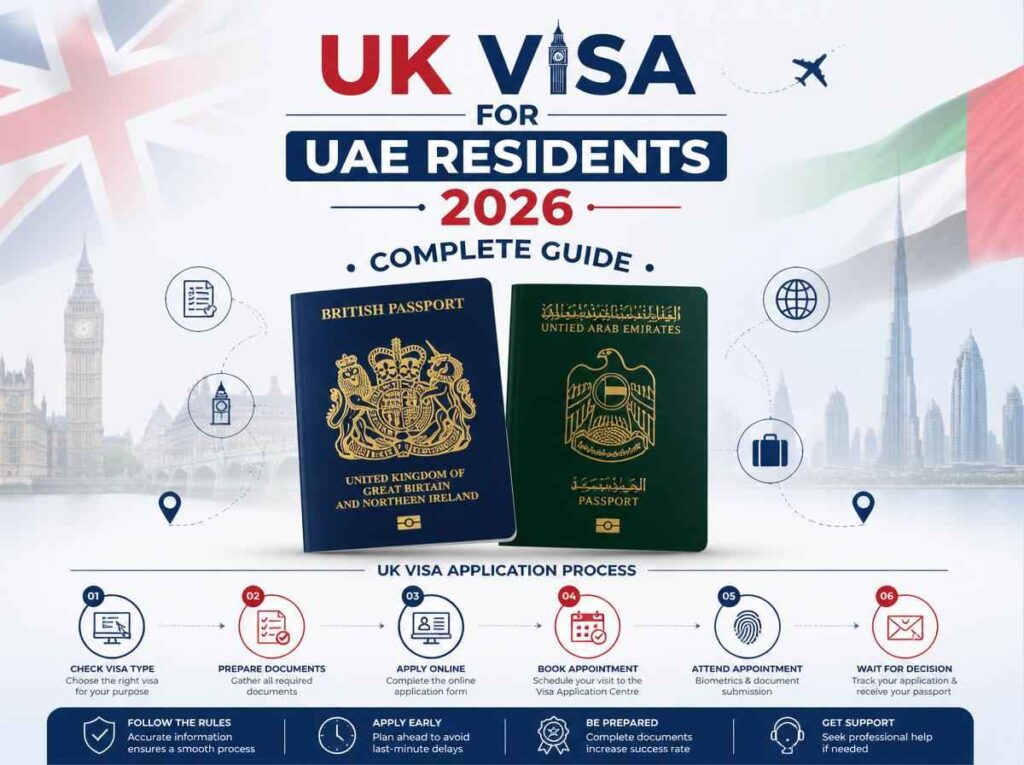
You’re based in Dubai, Abu Dhabi, or Sharjah. You want to travel to the UK. The first question you type is straightforward. The answer is not. Most guides online give you a standard document checklist and leave out the part that matters most: whether you need a UK visa at all depends entirely on your passport nationality, not your UAE residency. That single distinction trips up thousands of applicants every year. Get it wrong and you’re either wasting money on a visa you don’t need or boarding a flight without one you do. This guide gives you the full picture for 2026. It covers who needs what, what the new eVisa system means for you practically, what documents actually make or break an application, and where applications go wrong before they even reach a caseworker. Who Actually Needs a UK Visa from the UAE? Your UAE residence visa does not determine your UK visa requirement. Your passport does. This is the most common point of confusion, and it matters because the UAE is home to over 200 nationalities. Two colleagues sitting in the same Dubai office, both with valid Emirates IDs, can have completely different UK travel requirements based on their home countries. Here is the practical breakdown for 2026: Emirati nationals (UAE passport holders) UAE citizens do not need a Standard Visitor Visa for short visits to the UK. Since 22 February 2024, they instead need a UK Electronic Travel Authorisation (ETA) before departure. The ETA is not a visa. It is a digital pre-clearance linked to your passport. No biometric appointment is required. You apply online through the UK government’s official website or the UK ETA app. As of April 2026, the ETA costs £20 and is valid for two years from the date of issue, or until your passport expires, whichever comes first. Within that period, you can make unlimited trips to the UK. GCC nationals residing in the UAE Nationals of Bahrain, Kuwait, Oman, Qatar, and Saudi Arabia who are resident in the UAE are also eligible for the ETA rather than a Standard Visitor Visa. Qatar required ETAs from November 2023; the remaining GCC states from February 2024. All other nationalities If your passport is from India, Pakistan, Bangladesh, Egypt, Jordan, the Philippines, Nigeria, or any other country not on the UK’s visa-exempt list, you need a Standard Visitor Visa regardless of how long you’ve lived in the UAE. Your UAE residency lets you apply locally from within the UAE rather than travelling back to your home country, which is a meaningful practical benefit. Passport Nationality What You Need Application Method UAE (Emirati) ETA (£20) Online via gov.uk or UK ETA app GCC nationals (Bahraini, Kuwaiti, Omani, Qatari, Saudi) ETA (£20) Online via gov.uk or UK ETA app India, Pakistan, Bangladesh, Egypt, and most others Standard Visitor Visa Online application + VFS Global appointment EU nationals (with valid status) Check individual country Varies by passport Always verify your country’s status at gov.uk before applying, as this list is updated periodically. The UK eVisa System: What Changed in 2026 and Why It Matters Starting 25 February 2026, the UK Home Office completed its shift to a fully digital visa system. Physical visa vignette stickers in passports and Biometric Residence Permits (BRPs) have been replaced by eVisas for most immigration routes. For UAE-based applicants, this change has two significant practical effects. First, you no longer need to surrender your passport while your UK visa is being processed. Under the old system, applicants handed in their passports at VFS Global and waited. For frequent travellers in the UAE who might need their passport for other trips during that period, this was a real problem. Under the eVisa system, you attend VFS once for biometrics, take your passport home, and wait for an electronic decision by email. If approved, your visa status is linked digitally to your passport through a UKVI (UK Visas and Immigration) account. Second, there’s no more courier process. Once approved, there’s nothing to physically collect. Over 10 million people are already registered on the eVisa system globally, according to UKVI’s own data as of early 2026. The system is live and functioning, not a pilot. One thing to note: before travelling, you must log into your UKVI account and confirm your eVisa details are correct. Carriers check digital immigration status before boarding. Getting this wrong at the airport is avoidable with a five-minute check before your travel date. UK Standard Visitor Visa Requirements for UAE Residents in 2026 The UK Standard Visitor Visa allows stays of up to six months for tourism, family visits, business meetings, and short courses. For most UAE-based expats who need a visa, this is the correct route. Document Checklist This is the baseline document list for a Standard Visitor Visa application submitted from the UAE in 2026. Individual circumstances may require additional documents. Verify current requirements at gov.uk before submitting. Identity and status documents Financial evidence Purpose and ties Sponsor documents (if someone in the UK is covering your costs) UK Visitor Visa Fees from the UAE (2026) Fees increased on 8 April 2026. These are the current Home Office rates. VFS Global service charges apply separately and are not included below. Always confirm the exact fee on visa-fees.homeoffice.gov.uk on the day you submit, as rates can change. Visa Type Official UK Fee (USD) Approximate AED Standard Visitor (6 months) $189 / £135 ~694 AED Long-term Visitor (2 years) ~$690 / £506 ~2,532 AED Long-term Visitor (5 years) ~$1,230 / £903 ~4,514 AED Long-term Visitor (10 years) ~$1,537 / £1,128 ~5,641 AED Priority processing (add-on) +£500 approx. 5 working days Super priority (add-on) +£1,000 next working day AED conversions use the fixed peg of 3.67 AED per USD. Pound-to-dollar conversions vary. Verify on the Home Office fee calculator before payment. All visa fees are non-refundable. How to Apply: Step-by-Step from Dubai or Abu Dhabi The process is fully online except for one in-person biometric appointment. Here is how it

Umrah Packages from Abu Dhabi 2026: Bus, Air & Real Costs
Blog

Umrah Packages from Abu Dhabi 2026: Bus, Air & Real Costs

You’re comparing umrah packages from Abu Dhabi and you’ve seen prices anywhere from AED 1,050 to AED 6,000 for what looks like the same trip. Some ads say “visa included,” others say “without visa cost” in fine print. One agency quotes a 5-day trip, another quotes 10. Nobody tells you that under the 2026 Nusuk rules, your visa can expire before you even board if the agency issues it at the wrong time. That gap – between what’s advertised and what actually happens – is what most package listings leave out entirely. Whether you’re choosing between bus or air, economy or premium, a solo trip or a family of five, every decision here comes down to five specific variables. Al Nomadi Tourism handles Umrah packages from the UAE with full Nusuk-compliant processing across Abu Dhabi, Sharjah, and Dubai. What Is Actually Included in an Umrah Package from Abu Dhabi An Umrah package from Abu Dhabi is a bundled travel service covering, at minimum, your Saudi entry visa, transport to and between Makkah and Madinah, hotel accommodation near the Haram, and ziyarat (visits to religiously significant sites). That definition sounds simple. The problem is the word “minimum.” Most packages advertised at the lowest prices include the base four elements above but exclude meals, the MenACWY meningitis vaccination certificate (which is mandatory for all pilgrims aged 1 and above), and any single-room supplement. Some budget listings also exclude the Umrah visa fee entirely, calling it out in footnotes as a separate charge. If you’re comparing two prices without checking what each one actually covers, you’re not comparing the same product. A genuinely complete Umrah package includes: Anything not on that list is an extra. When comparing quotes, ask each agency to confirm in writing which of the above are included before you pay a deposit. The 2026 Nusuk Rule That Changes How Every Abu Dhabi Package Works The single biggest shift affecting Umrah packages from Abu Dhabi in 2026 is the “no booking, no visa” rule enforced by the Saudi Ministry of Hajj and Umrah through the Nusuk platform. This is not an optional system – it is the only official route to an Umrah visa, and it has fundamentally changed the sequence in which packages must be processed. Under the 2026-2027 (1448 AH) season rules confirmed by the Ministry of Hajj and Umrah: The practical implication for Abu Dhabi pilgrims: choose an agency that processes its packages in the correct Nusuk sequence, issues your visa close to your travel dates (not weeks earlier), and can provide a BRN before you make final payment. If an agency cannot explain what a Booking Reference Number is, find another agency. Umrah Packages from Abu Dhabi by Bus: Route, Timing, and Who It Suits An Umrah package from Abu Dhabi by bus is an overland journey that picks up from Abu Dhabi, passes through the UAE-Saudi border at the Batha crossing, stops at a designated meeqat point (usually near Taif, sometimes Yalamlam) for pilgrims to enter ihram, and continues directly to Makkah. The total travel time from Abu Dhabi to Makkah by road is approximately 16 to 18 hours including rest stops, border formalities, and the ihram stop. Standard Bus Package Structure Most bus Umrah packages from Abu Dhabi depart weekly – typically Wednesday mornings. The standard 10-day itinerary runs: This structure is fixed. Bus packages are not flexible on departure dates the way air tickets can be adjusted. If your leave window doesn’t accommodate a full 10 days, the bus route immediately stops making sense regardless of price. Who the Bus Route Is Right For Budget is the obvious driver, but it’s not the only one. Bus packages suit pilgrims who: Where the Bus Route Fails The bus route is the wrong choice for elderly pilgrims with mobility issues, anyone with a medical condition that makes long-duration seated travel difficult, families with children under 5 whose tolerance for a 16-hour journey is limited, and working professionals with exactly 5 or 7 days of leave. For all four of these groups, the time and physical cost of the bus route outweighs the cost saving, regardless of what the price difference looks like on paper. Umrah Packages from Abu Dhabi by Air: What Abu Dhabi’s Airport Advantage Means for You Abu Dhabi International Airport is home to Etihad Airways, which operates daily direct flights to Jeddah King Abdulaziz International Airport and to Prince Mohammed Bin Abdulaziz International Airport in Madinah. Flight time is approximately 3 hours to Jeddah and slightly less to Madinah direct. Saudia and flynas also serve these routes from Abu Dhabi, giving pilgrims multiple schedule options and competitive pricing, especially outside Ramadan. This is a genuine advantage that Abu Dhabi residents have over Sharjah-based pilgrims, who often route through Dubai for connecting flights. Direct departures from AUH mean shorter total journey times and more schedule flexibility. An Umrah package from Abu Dhabi by air typically covers: A 7-night air package from Abu Dhabi fits comfortably within a standard 10-day annual leave block, which is why it outsells bus packages among salaried professionals. Full Cost Breakdown: Bus vs Air from Abu Dhabi in 2026 Price comparisons between bus and air packages are only meaningful when you’re comparing the same inclusions. The tables below use market-standard inclusions as of mid-2026. All prices are directional – verify current figures with your agency before booking. Bus Package Costs from Abu Dhabi (Per Person) Package Type Room Sharing Estimated AED (excl. visa) Visa Added Cost Realistic Total Economy Bus Quad sharing 1,050 – 1,400 +330-450 1,380 – 1,850 Standard Bus Triple sharing 1,500 – 1,900 +330-450 1,830 – 2,350 Comfort Bus Double sharing 2,000 – 2,500 +330-450 2,330 – 2,950 Family Bus Private room 2,800 – 3,500 +330-450 3,130 – 3,950 All AED figures are market estimates for 2026 standard season travel. Ramadan prices run 40-80% higher. Prices subject to change – always verify with your agency. Air Package Costs from Abu Dhabi (Per Person) Package Type

Family Visa Processing Dubai: Time, Fees & Steps 2026
Blog

Family Visa Processing Dubai: Time, Fees & Steps 2026

You’ve secured your UAE residency, your salary clears the threshold, and you’re ready to bring your family over. Then someone tells you the processing takes “2 to 3 weeks” – and you don’t know if that means 10 working days or 21 calendar days, whether that clock starts from your application submission or from when your documents are verified, or what happens if one stage slows down. Family visa processing in Dubai is not a single application – it’s a multi-stage sequence, and the total time depends on which stage trips you up. Most guides quote the best-case number without explaining the variables that change it. This breakdown uses the actual 2026 process under the General Directorate of Residency and Foreigners Affairs (GDRFA) and the Federal Authority for Identity, Citizenship, Customs and Port Security (ICP) to give you the real picture. Al Nomadi Tourism handles complete family visa services across the UAE, including document preparation, portal submission, and end-to-end processing. What Is Family Visa Processing in Dubai – and Why It’s Not One Step Family visa processing in Dubai is a sequential, multi-authority process that takes a sponsored family member from entry permit through to a stamped UAE residence visa and Emirates ID. It is not a single application that produces a single result. The process involves three separate government entities – GDRFA (for Dubai-sponsored visas), the Dubai Health Authority (DHA) for medical fitness clearance, and the Federal Authority for Identity, Citizenship, Customs and Port Security (ICP) for Emirates ID issuance. Each authority has its own queue, its own processing window, and its own document requirements. Missing a step, or completing steps in the wrong order, doesn’t just slow things down – it restarts the clock on that specific stage. There’s also a structural split you need to know from the outset: if your own residence visa was issued in Dubai, your family’s visa application goes through GDRFA. If your visa was issued in Sharjah, Abu Dhabi, or any other emirate, the application goes through ICP. The core rules are largely the same, but the portals, fee structures, and some procedural details differ. This article covers the Dubai route – GDRFA-administered family visa processing – with notes on ICP differences where they matter. How Long Does Family Visa Processing Actually Take in Dubai? The realistic total for Dubai family visa processing is 2 to 4 weeks from the moment you submit a complete application – but that range breaks down very differently depending on whether your family member is applying from outside the UAE or converting a visit visa from inside. Family Member Applying from Outside the UAE This is the most common scenario. The process runs in five sequential stages: Stage What Happens Typical Working Days Stage 1: Entry Permit GDRFA issues a residence entry permit 2–5 working days Stage 2: Family Member Travels to Dubai After permit approval, they enter the UAE Depends on flights Stage 3: Medical Fitness Test DHA-approved centre completes test + results upload 1–2 working days Stage 4: Emirates ID Registration Biometrics and ICP submission 1–2 working days Stage 5: Residence Visa Stamp + Emirates ID Delivery GDRFA stamps residence visa; ICP mails Emirates ID 5–10 working days Total from entry permit to final ID Complete process ~2 to 3 weeks All timelines are working day estimates based on GDRFA and ICP standard service levels as of 2026. Express options are available at additional cost. Peak periods extend these estimates – see delay factors below. Family Member Already Inside the UAE on a Visit Visa If your spouse, children, or parents are already in the UAE on a tourist or visit visa, you can convert their status to a residence visa without them leaving the country – this is called an “inside country status change.” The timeline is similar, but the entry permit stage is replaced with an in-country application, and the entire process costs more due to additional inside-country processing fees. One critical timing rule: the status change application must be submitted before the existing visit visa expires. If it expires during processing, AED 50-per-day overstay fines apply automatically – the ICP standardised this rate across all visa categories effective 11 February 2026. There is no grace buffer on visit visas. If your family member’s visit visa is within 30 days of expiry when you start the process, begin immediately and consider express processing. What “2 to 3 Weeks” Actually Means in Practice Experienced visa processing agents typically describe this as: Entry permit approval in 3 working days on a clean application; medical test completed and results uploaded within 2 working days; Emirates ID biometrics done same day; visa stamp issued in 5–7 working days; physical Emirates ID arriving by courier in 4–5 working days after that. The total from portal submission to Emirates ID in hand is realistically 3 to 4 weeks for a first-time applicant handling everything personally, and closer to 2 to 2.5 weeks for an authorized agency with established portal access. The 3-Stage Document Attestation Error That Causes Most Processing Delays Documents cause more delays than salary mismatches or eligibility issues combined. Marriage certificates and birth certificates must complete three attestation stages – and the third stage is the one most applicants and even some guides miss entirely. Stage 1 – Home country authentication: For Indian nationals, this means State Home Department then Ministry of External Affairs (MEA) apostille. For Pakistani nationals: Home Department then Pakistan Ministry of Foreign Affairs. For Philippine nationals: PSA-issued documents then DFA authentication. Requirements vary by nationality – check with the relevant home authority first. Stage 2 – UAE Embassy attestation in the home country: The document is attested at the UAE Embassy or consulate in your home country before you bring it to the UAE. Stage 3 – UAE Ministry of Foreign Affairs (MOFA) attestation inside the UAE: This step happens after you arrive. The document must be attested again at a MOFA office or typing centre in the UAE before GDRFA

UAE Tourist Visa Extension 2026: Rules, Fees & Steps
Blog

UAE Tourist Visa Extension 2026: Rules, Fees & Steps

Your UAE tourist visa expires in five days and you’re not ready to leave. Or maybe you’re already planning ahead and want to know the rules before they catch you off guard. Either way, the tourist visa extension UAE process in 2026 is simpler than it was two years ago — but it’s also less forgiving. The grace period that many visitors relied on to buy themselves a few extra days? Gone. As of February 11, 2026, the Federal Authority for Identity, Citizenship, Customs and Port Security (ICP) introduced a unified AED 50-per-day fine for all visa types, starting on day one after expiry. No buffer. No exceptions for visit visa holders. Here’s exactly what your options are, what the full cost looks like, and how to apply before the clock runs out. Al Nomadi Tourism handles UAE visa services, including tourist visa extensions, for individuals across Sharjah and the wider UAE. What Is a UAE Tourist Visa Extension — and Who Can Actually Get One? A UAE tourist visa extension is a formal process that prolongs your legal stay in the country without requiring you to exit, cross a border, or apply for a fresh visa from outside the UAE. The extension is administered by the ICP for visas issued in Abu Dhabi, Sharjah, and the Northern Emirates, and by the General Directorate of Residency and Foreigners Affairs (GDRFA) for visas issued in Dubai. Not every visa qualifies. This is the part most articles skip past too quickly. Which Visa Types Can Be Extended Visa type Extension allowed? Maximum total stay 30-day single-entry tourist visa Yes — up to 2 times (30 days each) 90 days total 60-day tourist/visit visa Yes — once (30 days) 90 days total 5-year multiple-entry tourist visa Yes — once per visit (90 days) 180 days per year Visit visa for relatives/friends Yes — multiple extensions 180 days total Job exploration / business setup visa Yes — multiple extensions 180 days total On-arrival free visa (GCC-linked countries) Varies by nationality — check ICP Typically 30–90 days Transit visa (48 or 96 hours) No Not extendable Single-entry border/truck permits No Not extendable Note: These limits reflect ICP guidance as of mid-2026. Always verify your specific visa type and current rules on icp.gov.ae or gdrfad.gov.ae before applying, as policies change without public notice. The absolute ceiling for standard tourist visa holders is 120 days of cumulative stay per visa cycle. Reach that, and you must exit regardless of how many extensions remain unused. The February 2026 Fine Change: Why It Matters More Than You Think Before February 11, 2026, overstay fines varied by emirate and visa type, and Dubai applied a first-day surcharge that differed from ICP rules. That patchwork is gone. The ICP formally switched the country to a unified fine system on 11 February 2026, standardising the penalty at AED 50 per day across all visa categories and all seven emirates. The part that catches people out: pre-arranged tourist and visit visas carry no grace period. Fines begin accruing from the first day after the visa expires. That’s not a technicality. A 10-day overstay — common among visitors who assume there’s a buffer — now costs AED 500, plus a potential departure complication if the fine isn’t cleared before you reach the airport. If your overstay exceeds 30 days, the situation escalates further. You can’t leave the UAE without first obtaining an exit permit (called an out-pass), which costs approximately AED 250–300 from GDRFA in Dubai, or slightly less through ICP for other emirates. That’s separate from, and on top of, the daily fine already accrued. The lesson is simple: apply for your extension before the visa expires, not after you’ve already gone over. Processing typically takes one to five working days, so submitting five to seven days before your expiry date is the right window. How Much Does a UAE Tourist Visa Extension Cost? Full Breakdown Headline prices on most agency websites quote AED 600–630 and stop there. The actual cost depends on whether your visa was issued by ICP or GDRFA and whether you’re applying from inside the country. GDRFA Dubai — Tourist Visa Extension Fees The GDRFA extension fee is AED 600, plus 5% VAT. If the sponsored person is already inside the country, additional fees apply: AED 10 Knowledge Dirham, AED 10 Innovation Dirham, and AED 500 inside-country processing fee. That means an in-country extension via GDRFA Dubai can total approximately AED 1,130–1,150 when all fees are included — well above the AED 630 figure many listings show. Agency service charges sit on top of this. ICP — Sharjah and Northern Emirates Fees A standard tourist visa extension through ICP costs approximately AED 600 plus VAT, with additional government fees (Knowledge and Innovation fee) of AED 10 each. In-country surcharges apply similarly. Fee component ICP (Sharjah/other) GDRFA (Dubai) Base extension fee ~AED 600 + VAT ~AED 600 + VAT Knowledge & Innovation Dirham AED 10 + AED 10 AED 10 + AED 10 Inside-country processing fee ~AED 500 ~AED 500 Agency service charge (if used) Varies Varies Approximate total (in-country) ~AED 1,130 ~AED 1,130–1,150 Express or urgent processing costs more — typically an additional AED 150–200 — and processes in 24–48 hours versus the standard 3–5 working days. Always verify current fee schedules directly on icp.gov.ae or gdrfad.gov.ae before submitting payment. Fees are subject to change by the relevant authorities. Step-by-Step: How to Extend Your UAE Tourist Visa Without Leaving You don’t need to visit a border crossing or book a visa-run flight. The entire process is available online, and most approvals come through by email or through the portal itself within the standard processing window. Before you start, confirm two things: your visa is still valid (not expired), and your visa type is extendable based on the table above. One thing worth knowing from the agency side: applications submitted during school holidays, the December peak season, or in the week before Eid can take longer than the standard

Umrah Packages from Sharjah 2026: Bus vs Air Costs
Blog

Umrah Packages from Sharjah 2026: Bus vs Air Costs

Booking umrah packages from Sharjah used to mean one phone call to a local agent and a price on a piece of paper. That’s changed. Saudi Arabia’s Nusuk platform now controls how visas get issued, bus operators have adjusted routes around new entry rules, and “cheapest” listings online rarely show what’s missing from the quote. If you’re comparing umrah packages from Sharjah by bus against flying, or trying to work out why one “best umrah packages from Sharjah” ad is AED 1,500 and another is AED 6,000 for what looks like the same trip, the difference usually comes down to five specific things this guide walks through. Al Nomadi Tourism, based in the UAE, builds packages around these exact variables — so you’re choosing with full information, not guessing. If you’re mid-search right now, bookmark this page. It covers the pricing breakdown, the visa rule that trips up first-time bookers, and the honest comparison between bus and air travel before you commit to either. What’s Actually Inside an Umrah Package from Sharjah An umrah package from Sharjah is a bundled service that combines your Saudi entry visa, transport to Makkah and Madinah, hotel accommodation near the Haram, and guided ziyarat (visits to historically significant sites). The bundling exists because these four elements are now interdependent — Saudi Arabia’s Nusuk platform requires your visa application to be linked to confirmed hotel and transport bookings before it will issue a permit at all. That’s a meaningful shift from how this worked even two years ago, when a pilgrim could get a visa first and sort out logistics after landing. Under the current “no booking, no visa” rule, the sequence is reversed: book your accommodation and transport through a Nusuk-linked provider, then the visa gets issued against that booking. Agencies operating out of Sharjah, Dubai, and Abu Dhabi that aren’t set up to process Nusuk-compliant bookings will either delay your application or push you toward a workaround that risks rejection. A standard package typically includes: What’s usually excluded, and what most Sharjah-based agency sites don’t state clearly: meals (unless specifically marked “full board”), the MenACWY meningitis vaccination certificate you’re required to carry, and any single-room supplement if you don’t want to share. Umrah Packages from Sharjah by Bus: Route, Timing, and Who It Actually Suits An umrah package from Sharjah by bus moves pilgrims overland through Saudi Arabia’s western border crossing, with a stop at a meeqat point — commonly Yalamlam or a designated mosque near Taif — to enter the state of ihram before continuing to Makkah. Most operators run this on a fixed weekly cycle rather than daily departures, which matters more than most listings let on. The Typical Bus Schedule A common structure looks like this: departure from Sharjah on a Wednesday morning, arrival in Makkah by Thursday afternoon after the ihram stop, five nights in Makkah including Friday Jumu’ah at Masjid al-Haram, then an overland transfer to Madinah for three nights, with a return to Sharjah roughly nine to ten days after departure. Groups usually travel with an experienced guide who manages the ihram process and rituals for first-timers. The bus format works well if your budget is the deciding factor and your schedule allows a full nine or ten days off — not a long weekend. It does not work well if you have a fixed short leave window, a medical condition that makes 15+ hours of overland travel difficult, or you’re traveling with young children who’ll struggle with the journey length. In our review of packages built for these longer land routes, the trade-off is almost always time for cost: a bus package can run 40 to 60% cheaper than the equivalent air package, but it consumes three to four extra days of leave. Who Should Skip the Bus Option If you’re a solo woman under 45 traveling without a mahram, note that unaccompanied female travel rules for Umrah still generally require either a mahram or, for some nationalities and older age brackets, specific exemptions — this applies regardless of whether you go by bus or air, and it’s worth confirming your exact eligibility with the agency before paying a deposit. If you’re on a UAE visit visa rather than a resident visa, your visa costs and required documents differ from a resident’s, and not every advertised “cheapest” bus rate applies to you — this is one of the most common gaps between the advertised price and what a visit-visa holder actually pays. Cheapest Umrah Packages from Sharjah: What the Price Doesn’t Include The cheapest umrah packages from Sharjah advertised online typically start around AED 1,500 to 1,800 for an economy bus package with shared accommodation, based on current market listings from Sharjah-based agencies. That figure is real, but it’s also incomplete on almost every ad you’ll see. Here’s what usually sits outside the headline price: Cost factor Typical additional cost (AED) Why it’s separate Umrah visa fee 330–450 Quoted “without visa” on many listings; covers the SAR 300 eVisa fee plus service charges MenACWY vaccination 80–200 Mandatory for all pilgrims aged 1+; must be taken at least 10 days before arrival Single room supplement 400–1,200 Base price assumes 4-to-a-room sharing Meals (if not full board) 300–600 Many “economy” packages cover transport and hotel only Ihram kit / Zamzam allowance 50–150 Sometimes bundled, sometimes not — always ask directly Add these up and a AED 1,500 headline package can realistically land at AED 2,600–3,300 once visa, vaccination, and a private room are factored in. This isn’t a criticism of the pricing model — it’s simply how the market structures its ads. A trustworthy agency will break this down for you before you pay a deposit rather than after. One short rule worth remembering: if a quote doesn’t separate the visa cost from the package cost, ask why. Best Umrah Packages from Sharjah: How to Judge Quality Beyond Price The best umrah packages from Sharjah aren’t simply the ones with the lowest number attached — they’re the

Scroll to Top

You Can Contact Us If You Have Any Query