
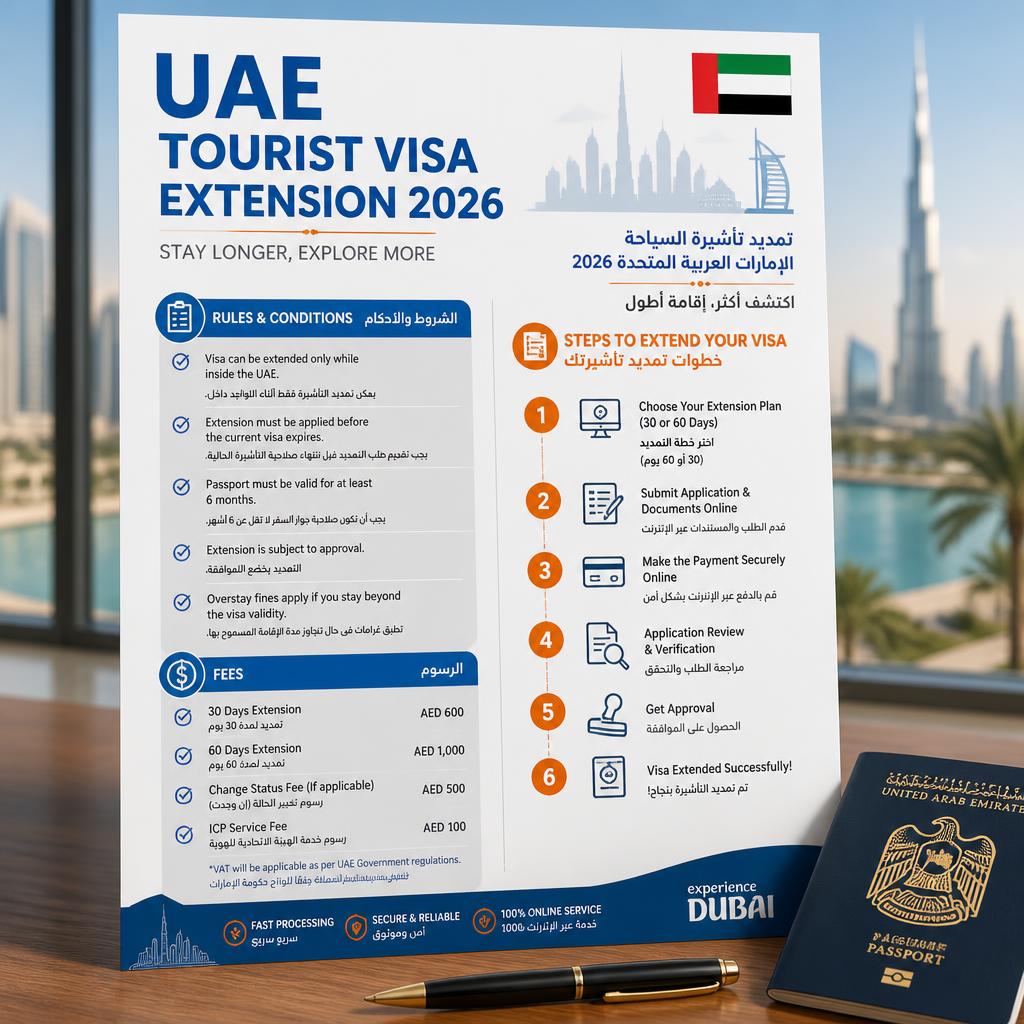
Your UAE tourist visa expires in five days and you’re not ready to leave. Or maybe you’re already planning ahead and want to know the rules before they catch you off guard. Either way, the tourist visa extension UAE process in 2026 is simpler than it was two years ago — but it’s also less forgiving. The grace period that many visitors relied on to buy themselves a few extra days? Gone. As of February 11, 2026, the Federal Authority for Identity, Citizenship, Customs and Port Security (ICP) introduced a unified AED 50-per-day fine for all visa types, starting on day one after expiry. No buffer. No exceptions for visit visa holders.
Here’s exactly what your options are, what the full cost looks like, and how to apply before the clock runs out. Al Nomadi Tourism handles UAE visa services, including tourist visa extensions, for individuals across Sharjah and the wider UAE.
What Is a UAE Tourist Visa Extension — and Who Can Actually Get One?
A UAE tourist visa extension is a formal process that prolongs your legal stay in the country without requiring you to exit, cross a border, or apply for a fresh visa from outside the UAE. The extension is administered by the ICP for visas issued in Abu Dhabi, Sharjah, and the Northern Emirates, and by the General Directorate of Residency and Foreigners Affairs (GDRFA) for visas issued in Dubai.
Not every visa qualifies. This is the part most articles skip past too quickly.
Which Visa Types Can Be Extended
| Visa type | Extension allowed? | Maximum total stay |
|---|---|---|
| 30-day single-entry tourist visa | Yes — up to 2 times (30 days each) | 90 days total |
| 60-day tourist/visit visa | Yes — once (30 days) | 90 days total |
| 5-year multiple-entry tourist visa | Yes — once per visit (90 days) | 180 days per year |
| Visit visa for relatives/friends | Yes — multiple extensions | 180 days total |
| Job exploration / business setup visa | Yes — multiple extensions | 180 days total |
| On-arrival free visa (GCC-linked countries) | Varies by nationality — check ICP | Typically 30–90 days |
| Transit visa (48 or 96 hours) | No | Not extendable |
| Single-entry border/truck permits | No | Not extendable |
Note: These limits reflect ICP guidance as of mid-2026. Always verify your specific visa type and current rules on icp.gov.ae or gdrfad.gov.ae before applying, as policies change without public notice.
The absolute ceiling for standard tourist visa holders is 120 days of cumulative stay per visa cycle. Reach that, and you must exit regardless of how many extensions remain unused.
The February 2026 Fine Change: Why It Matters More Than You Think
Before February 11, 2026, overstay fines varied by emirate and visa type, and Dubai applied a first-day surcharge that differed from ICP rules. That patchwork is gone. The ICP formally switched the country to a unified fine system on 11 February 2026, standardising the penalty at AED 50 per day across all visa categories and all seven emirates.
The part that catches people out: pre-arranged tourist and visit visas carry no grace period. Fines begin accruing from the first day after the visa expires.
That’s not a technicality. A 10-day overstay — common among visitors who assume there’s a buffer — now costs AED 500, plus a potential departure complication if the fine isn’t cleared before you reach the airport.
If your overstay exceeds 30 days, the situation escalates further. You can’t leave the UAE without first obtaining an exit permit (called an out-pass), which costs approximately AED 250–300 from GDRFA in Dubai, or slightly less through ICP for other emirates. That’s separate from, and on top of, the daily fine already accrued.
The lesson is simple: apply for your extension before the visa expires, not after you’ve already gone over. Processing typically takes one to five working days, so submitting five to seven days before your expiry date is the right window.
How Much Does a UAE Tourist Visa Extension Cost? Full Breakdown
Headline prices on most agency websites quote AED 600–630 and stop there. The actual cost depends on whether your visa was issued by ICP or GDRFA and whether you’re applying from inside the country.
GDRFA Dubai — Tourist Visa Extension Fees
The GDRFA extension fee is AED 600, plus 5% VAT. If the sponsored person is already inside the country, additional fees apply: AED 10 Knowledge Dirham, AED 10 Innovation Dirham, and AED 500 inside-country processing fee.
That means an in-country extension via GDRFA Dubai can total approximately AED 1,130–1,150 when all fees are included — well above the AED 630 figure many listings show. Agency service charges sit on top of this.
ICP — Sharjah and Northern Emirates Fees
A standard tourist visa extension through ICP costs approximately AED 600 plus VAT, with additional government fees (Knowledge and Innovation fee) of AED 10 each. In-country surcharges apply similarly.
| Fee component | ICP (Sharjah/other) | GDRFA (Dubai) |
|---|---|---|
| Base extension fee | ~AED 600 + VAT | ~AED 600 + VAT |
| Knowledge & Innovation Dirham | AED 10 + AED 10 | AED 10 + AED 10 |
| Inside-country processing fee | ~AED 500 | ~AED 500 |
| Agency service charge (if used) | Varies | Varies |
| Approximate total (in-country) | ~AED 1,130 | ~AED 1,130–1,150 |
Express or urgent processing costs more — typically an additional AED 150–200 — and processes in 24–48 hours versus the standard 3–5 working days.
Always verify current fee schedules directly on icp.gov.ae or gdrfad.gov.ae before submitting payment. Fees are subject to change by the relevant authorities.
Step-by-Step: How to Extend Your UAE Tourist Visa Without Leaving
You don’t need to visit a border crossing or book a visa-run flight. The entire process is available online, and most approvals come through by email or through the portal itself within the standard processing window.
Before you start, confirm two things: your visa is still valid (not expired), and your visa type is extendable based on the table above.
- Identify who issued your visa. Check the visa sticker in your passport. If it was issued in Dubai, you use the GDRFA portal. If it was issued in Sharjah, Abu Dhabi, or any other emirate, you use the ICP Smart Services portal at smartservices.icp.gov.ae.
- Log in with UAE Pass. Both portals are connected to UAE Pass, the national digital identity system. If you don’t have UAE Pass, you can register on the UAE Pass app using your Emirates ID and passport details.
- Gather your documents digitally. You’ll need: a scanned copy of your passport (valid for at least 6 months from your intended stay period), a copy of your current visa, a passport-size photograph (white background), and proof of accommodation such as a confirmed hotel booking or tenancy contract.
- Submit the extension application. Select “tourist visa extension” or “extend entry permit,” fill in the application form, upload your documents, and pay the applicable fees.
- Track your application. Use the application reference number to check status through the same portal. You’ll receive email notification when the extension is approved.
- Download and keep the updated visa. Once approved, save the digital copy. You’ll need it at immigration departure.
One thing worth knowing from the agency side: applications submitted during school holidays, the December peak season, or in the week before Eid can take longer than the standard 3–5 days. If your expiry date lands in any of these periods, start your application eight to ten days ahead rather than the usual five to seven.
When the Extension Option Doesn’t Work for You
Most guides treat tourist visa extensions as a guaranteed solution. They’re not. Four specific situations make the standard extension route either unavailable or inadvisable.
Situation 1: You’ve already used both extensions. A 30-day tourist visa allows two 30-day extensions — after that, you’ve hit the 90-day ceiling and must exit before the 120-day absolute limit. There’s no third extension option under current ICP rules.
Situation 2: Your visa was issued on an on-arrival basis and the rules for your nationality differ. Nationals of some countries receive on-arrival entry under bilateral agreements that operate under different extension parameters. Don’t assume the standard tourist extension rules apply to you — check ICP’s nationality-specific guidance or ask an authorized agency before submitting.
Situation 3: You’ve secured a job offer and want to stay. An extension only keeps you legal as a tourist. If you’ve been offered employment while in the UAE, a status change — not an extension — is the right route. <cite index=”35-1″>Visitors who secure employment or meet residency eligibility criteria may convert their visit visa to a residence permit without leaving the UAE. The process requires a status change application submitted through ICP or GDRFA, and for employment-based conversions, the employer applies for a MOHRE work permit.</cite> The key requirement: your current visa must still be valid when the status change application is submitted.
Situation 4: Your extension application is rejected. Rejections do happen — common causes include document mismatches, an already-expired visa at time of submission, or a visa type that doesn’t qualify. If your application is rejected and your visa has since expired, you’re in overstay territory and fines are already running. The correct move is to settle the outstanding fine through ICP or GDRFA Smart Services, obtain an exit permit if your overstay exceeds 30 days, and exit the UAE. Staying further without acting makes the situation materially worse.
Visa Extension vs. Border Run: Which Makes More Sense in 2026?
For years, a quick border crossing to Hatta or into Oman reset the visa clock for many visitors. That option technically still exists, but it’s no longer the smarter or cheaper choice for most people.
Doing a border run means giving up your current visa, exiting, and re-entering on a fresh entry. You then start a new visa cycle — which costs the price of a new visa, border fees, transport, and several hours of your day. In-country extensions through ICP or GDRFA cost approximately AED 1,130 and involve no travel at all.
There are two scenarios where a border run might still make sense: if you’ve maxed out your extension allowance and genuinely need another 30-day visa cycle, or if your visa type is non-extendable (like a transit visa) and you legitimately need to restart. In both cases, the exit is legally required — it’s not a workaround.
If you still have unused extensions available, an in-country extension is almost always the better option on cost, time, and legal risk. Border runs carry their own complications if your passport history or visa record draws scrutiny at re-entry.
If you’re unsure which option applies to your situation, it’s worth getting a specific answer from an authorized UAE visa service provider before you act — not after.
Booking Your Tourist Visa Extension Through an Authorized Agency
Applying directly through ICP or GDRFA is free of agency charges, but it requires you to navigate the portals correctly, match document formats to requirements, and submit within the right timing window. For many visitors — especially first-timers or those with non-standard visa types — the risk of a rejected application or a missed fee is real.
Authorized agencies like Al Nomadi Tourism handle the full extension process: portal submission, document preparation, fee payment, and status tracking. The service fee adds cost, but it removes the risk of a documentation error that delays your application past your expiry date.
Whether you use Al Nomadi’s visa services or apply directly, the same checklist applies:
- Confirm your visa type is extendable (check the table above)
- Confirm you haven’t exceeded your extension count
- Passport valid for at least 6 months from your requested extension date
- Current visa copy — clear scan, not a photo of the sticker
- Passport-size photograph — white background, recent
- Proof of accommodation in the UAE
- Budget for in-country fees, not just the headline extension rate
- Submit at least 5–7 business days before expiry (10 days if applying during peak season)
The only thing that genuinely can’t be fixed after the fact is submitting after your visa has already expired. Every other complication — wrong document format, missing photograph, incorrect fee amount — can be corrected and resubmitted. An already-expired visa cannot be extended retroactively.
Final Word: Don’t Wait Until the Last Day
The tourist visa extension UAE process in 2026 is genuinely straightforward when you act on time. The ICP unified fine system introduced in February 2026 removed any ambiguity about the cost of waiting: AED 50 per day, from day one, on every visa type, across all seven emirates. There is no buffer, no informal grace period, and no amnesty programme currently active for standard overstays.
If your visa is expiring within the next 10 days and you intend to stay, start your application now — not tomorrow. If you’re already in overstay, clear the fine through ICP or GDRFA Smart Services before you travel to the airport. If you’re approaching the 30-day overstay mark, get the exit permit sorted first.
Al Nomadi Tourism provides UAE visa extension assistance including document preparation, ICP and GDRFA portal submissions, and status follow-up for tourists and visitors across Sharjah and the UAE. Verify current fees and service details directly on the official Al Nomadi website before submitting any application.
The best UAE visa strategy is simple: don’t let the expiry date come to you. Go to it first.
FAQ SECTION
1. Can I extend my UAE tourist visa without leaving the country? Yes. In-country tourist visa extensions are fully permitted under 2026 UAE rules. You apply online through the ICP portal (for Sharjah, Abu Dhabi, and the Northern Emirates) or the GDRFA portal (for Dubai), upload your documents, pay the fee, and receive the updated visa by email. No border crossing is required. Your current visa must still be valid at the time of application.
2. How much does a UAE tourist visa extension cost in 2026? The base government fee is approximately AED 600 plus 5% VAT. If you’re already inside the UAE, an additional in-country processing fee of AED 500 and AED 10 each for Knowledge and Innovation Dirham fees apply, bringing the realistic total to around AED 1,130–1,150. Agency service charges are separate. Always verify the current fee schedule on icp.gov.ae or gdrfad.gov.ae before paying.
3. What is the fine for overstaying a UAE tourist visa? The ICP unified the overstay fine at AED 50 per day across all visa types and all emirates, effective February 11, 2026. Fines start accruing on the first day after your visa expires — there is no grace period for tourist or visit visa holders. If your overstay exceeds 30 days, you also need an exit permit (approximately AED 250–300) before you can depart.
4. How many times can I extend a UAE tourist visa? A 30-day tourist visa can be extended twice, each time for 30 days, giving a maximum stay of 90 days. A 60-day tourist visa can be extended once for 30 days, also capping at 90 days. The absolute maximum cumulative stay for tourist visa holders under any extension scenario is 120 days. After that, you must exit the UAE.
5. What documents do I need to extend a UAE tourist visa? You’ll need: a valid passport with at least six months’ remaining validity, a clear copy of your current visa or entry permit, a recent passport-size photograph (white background), and proof of accommodation such as a confirmed hotel booking or tenancy agreement. Some cases may require a return flight ticket or additional supporting documents — confirm with ICP or your agency before submitting.
6. Can I change my tourist visa status to a residence visa without exiting the UAE? Yes, if you qualify. Visitors who receive a job offer, qualify for a Golden Visa or Green Visa, or meet other residency criteria can apply for a status change inside the UAE without leaving. Your current visa must still be valid at the time of application. For employment-based conversions, the employer files for a MOHRE work permit as part of the process.