
You’re based in Dubai, Abu Dhabi, or Sharjah. You want to travel to the UK. The first question you type is straightforward. The answer is not.
Most guides online give you a standard document checklist and leave out the part that matters most: whether you need a UK visa at all depends entirely on your passport nationality, not your UAE residency. That single distinction trips up thousands of applicants every year. Get it wrong and you’re either wasting money on a visa you don’t need or boarding a flight without one you do.
This guide gives you the full picture for 2026. It covers who needs what, what the new eVisa system means for you practically, what documents actually make or break an application, and where applications go wrong before they even reach a caseworker.
Who Actually Needs a UK Visa from the UAE?
Your UAE residence visa does not determine your UK visa requirement. Your passport does.
This is the most common point of confusion, and it matters because the UAE is home to over 200 nationalities. Two colleagues sitting in the same Dubai office, both with valid Emirates IDs, can have completely different UK travel requirements based on their home countries.
Here is the practical breakdown for 2026:
Emirati nationals (UAE passport holders) UAE citizens do not need a Standard Visitor Visa for short visits to the UK. Since 22 February 2024, they instead need a UK Electronic Travel Authorisation (ETA) before departure. The ETA is not a visa. It is a digital pre-clearance linked to your passport. No biometric appointment is required. You apply online through the UK government’s official website or the UK ETA app. As of April 2026, the ETA costs £20 and is valid for two years from the date of issue, or until your passport expires, whichever comes first. Within that period, you can make unlimited trips to the UK.
GCC nationals residing in the UAE Nationals of Bahrain, Kuwait, Oman, Qatar, and Saudi Arabia who are resident in the UAE are also eligible for the ETA rather than a Standard Visitor Visa. Qatar required ETAs from November 2023; the remaining GCC states from February 2024.
All other nationalities If your passport is from India, Pakistan, Bangladesh, Egypt, Jordan, the Philippines, Nigeria, or any other country not on the UK’s visa-exempt list, you need a Standard Visitor Visa regardless of how long you’ve lived in the UAE. Your UAE residency lets you apply locally from within the UAE rather than travelling back to your home country, which is a meaningful practical benefit.
| Passport Nationality | What You Need | Application Method |
|---|---|---|
| UAE (Emirati) | ETA (£20) | Online via gov.uk or UK ETA app |
| GCC nationals (Bahraini, Kuwaiti, Omani, Qatari, Saudi) | ETA (£20) | Online via gov.uk or UK ETA app |
| India, Pakistan, Bangladesh, Egypt, and most others | Standard Visitor Visa | Online application + VFS Global appointment |
| EU nationals (with valid status) | Check individual country | Varies by passport |
Always verify your country’s status at gov.uk before applying, as this list is updated periodically.
The UK eVisa System: What Changed in 2026 and Why It Matters
Starting 25 February 2026, the UK Home Office completed its shift to a fully digital visa system. Physical visa vignette stickers in passports and Biometric Residence Permits (BRPs) have been replaced by eVisas for most immigration routes.
For UAE-based applicants, this change has two significant practical effects.
First, you no longer need to surrender your passport while your UK visa is being processed. Under the old system, applicants handed in their passports at VFS Global and waited. For frequent travellers in the UAE who might need their passport for other trips during that period, this was a real problem. Under the eVisa system, you attend VFS once for biometrics, take your passport home, and wait for an electronic decision by email. If approved, your visa status is linked digitally to your passport through a UKVI (UK Visas and Immigration) account.
Second, there’s no more courier process. Once approved, there’s nothing to physically collect.
Over 10 million people are already registered on the eVisa system globally, according to UKVI’s own data as of early 2026. The system is live and functioning, not a pilot.
One thing to note: before travelling, you must log into your UKVI account and confirm your eVisa details are correct. Carriers check digital immigration status before boarding. Getting this wrong at the airport is avoidable with a five-minute check before your travel date.
UK Standard Visitor Visa Requirements for UAE Residents in 2026
The UK Standard Visitor Visa allows stays of up to six months for tourism, family visits, business meetings, and short courses. For most UAE-based expats who need a visa, this is the correct route.
Document Checklist
This is the baseline document list for a Standard Visitor Visa application submitted from the UAE in 2026. Individual circumstances may require additional documents. Verify current requirements at gov.uk before submitting.
Identity and status documents
- Valid passport with at least one blank page and validity covering your full trip
- Previous passports if they contain prior UK visas or significant travel history
- Valid UAE residence visa (copy)
- Emirates ID (both sides, clear copy)
- Completed online application form with the printed GWF reference number
Financial evidence
- Personal bank statements covering the last three to six months
- Regular salary credits, consistent balance, and no large unexplained cash deposits
- Salary certificates or employment letters on company letterhead
- If self-employed: trade licence, audited accounts, or business bank statements
Purpose and ties
- Hotel booking confirmations or a letter of invitation from a UK-based contact
- Travel itinerary or flight booking reference
- Evidence of ties to the UAE that show you intend to return: employment contract, property lease, children enrolled in UAE schools, or similar
Sponsor documents (if someone in the UK is covering your costs)
- Sponsor’s passport copy
- Sponsor’s proof of UK address
- Sponsor’s bank statements
- A signed letter explaining the nature of the relationship and confirming financial support
UK Visitor Visa Fees from the UAE (2026)
Fees increased on 8 April 2026. These are the current Home Office rates. VFS Global service charges apply separately and are not included below. Always confirm the exact fee on visa-fees.homeoffice.gov.uk on the day you submit, as rates can change.
| Visa Type | Official UK Fee (USD) | Approximate AED |
|---|---|---|
| Standard Visitor (6 months) | $189 / £135 | ~694 AED |
| Long-term Visitor (2 years) | ~$690 / £506 | ~2,532 AED |
| Long-term Visitor (5 years) | ~$1,230 / £903 | ~4,514 AED |
| Long-term Visitor (10 years) | ~$1,537 / £1,128 | ~5,641 AED |
| Priority processing (add-on) | +£500 | approx. 5 working days |
| Super priority (add-on) | +£1,000 | next working day |
AED conversions use the fixed peg of 3.67 AED per USD. Pound-to-dollar conversions vary. Verify on the Home Office fee calculator before payment. All visa fees are non-refundable.
How to Apply: Step-by-Step from Dubai or Abu Dhabi
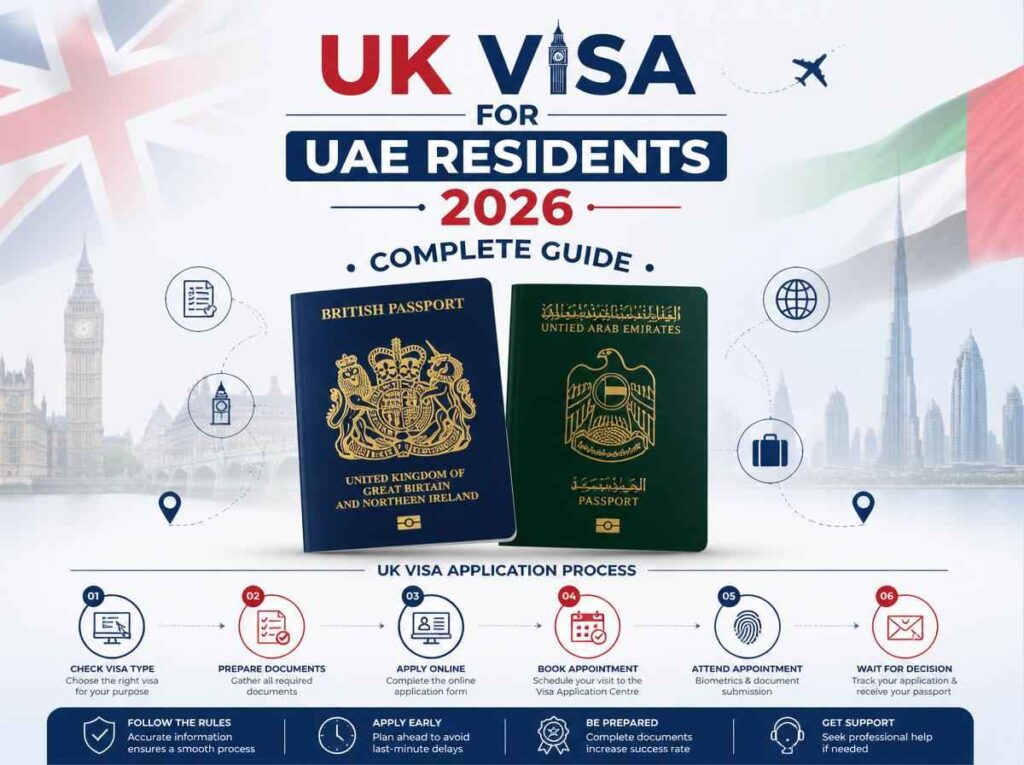
The process is fully online except for one in-person biometric appointment. Here is how it works in sequence.
- Confirm your visa type. Check gov.uk to verify your nationality requires a Standard Visitor Visa, not an ETA or another route.
- Complete the online application. Go to gov.uk and fill in the application form. Take your time with this. Inconsistencies between your form and your supporting documents are one of the top reasons applications are delayed or refused.
- Pay the visa fee online. Payment is made by card at the time of submission. There is no payment at VFS.
- Book your biometric appointment. After paying, you’ll be directed to book at a VFS Global Visa Application Centre. Centres in the UAE are located in Dubai, Abu Dhabi, Sharjah, Al Ain, and Ajman. Book the earliest available slot.
- Attend your VFS appointment. Bring your passport, printed application confirmation (GWF reference), and your document file. At the centre, your fingerprints and photograph are recorded. Under the new eVisa system, you leave with your passport.
- Wait for the decision. Standard processing takes approximately three weeks (15 working days) from the date of your biometric appointment. Priority and super-priority options are available for an additional fee, with decisions in five working days or the next working day respectively.
- Access your eVisa. If approved, you’ll receive an email with instructions to access your UKVI account. Check your eVisa details before your travel date.
What Actually Gets UK Visa Applications Refused
Most articles on this topic stop at the document checklist. That’s where the useful information begins.
In reviewing patterns across South Asian, Arab, and African passport holders applying from the UAE, the most common reasons for UK visitor visa refusals from this region fall into a handful of categories.
Weak financial evidence. UK caseworkers look for a consistent pattern of income and savings, not just a high balance right before the application. A salary that arrives reliably every month, combined with three to six months of statements showing regular spending and a reasonable buffer, is far stronger than a large recent deposit with no explanation.
No clear ties to the UAE. The question the caseworker is implicitly asking is: will this person leave the UK when their visa expires? Evidence of an active life in the UAE, a job they need to return to, a tenancy agreement, a child in school, family dependents, significantly strengthens this case. Applicants who are between jobs, on freelance income, or recently arrived in the UAE face a harder task proving this.
Vague or generic purpose of visit. “Tourism” alone is not enough. A specific itinerary, confirmed hotel bookings, maybe tickets to an event, shows the caseworker a real trip, not a cover story. This is especially important for first-time applicants.
Application form inconsistencies. This is the one that blindsides people. If your stated monthly income on the form doesn’t match your salary slips, or your employer name differs slightly from what’s on your Emirates ID, caseworkers flag it. These are usually honest oversights, but they create grounds for doubt.
Prior refusals not disclosed. The application form asks about previous visa refusals. Omitting them, even for unrelated countries or old applications, is treated seriously. Disclose, and provide context.
Who Should Consider a Long-Term UK Visitor Visa
The six-month Standard Visitor Visa makes sense for a single trip. But if you’re a UAE resident who travels to the UK regularly, for family, for business, or for property reasons, the long-term visitor options are worth knowing.
A two-year, five-year, or ten-year multi-entry UK visitor visa allows unlimited trips to the UK within its validity period, with each stay capped at six months. You don’t need to reapply before every trip.
This is particularly relevant for South Asian professionals in the UAE with family in the UK, business owners who attend UK-based conferences or supplier meetings, and UAE residents who own property in the UK. For these groups, the annual cost-per-visit calculation often makes the long-term option the better financial decision after the second or third trip.
Long-term visas are not automatically granted. UKVI typically issues them to applicants with a strong existing travel history to the UK, clean immigration records, and well-established financial ties. First-time applicants are more likely to be issued a six-month visa initially.
Common Scenarios: What Your Situation Actually Means
Indian professional working in Dubai, family holiday to London You need a Standard Visitor Visa. Apply from Dubai via VFS. Use your UAE bank statements and employment letter. Processing is approximately three weeks. If your travel dates are firm and close, the priority service at an additional £500 brings the decision window to five working days.
Pakistani family in Sharjah visiting relatives in Manchester Same route as above. One additional document you’ll likely need: a letter of invitation from your UK-based relatives confirming they are hosting you, along with their proof of UK address and status. If your relatives are covering accommodation costs, include their financial evidence too.
Emirati national planning a shopping trip to London You don’t need a visa at all. Apply for a UK ETA online at gov.uk or through the UK ETA app. The process takes minutes, costs £20, and you can travel within days of approval. No VFS appointment required.
Filipino domestic worker in Abu Dhabi wanting to visit the UK This is one of the harder cases in practice. Strong financial evidence is essential because UAE-based domestic workers often have lower documented savings relative to UK trip costs. A clear letter from your employer confirming your employment and return to the UAE, combined with three to six months of consistent bank statements, is the foundation. If a UK-based family member is hosting you and covering costs, a complete sponsorship package from them materially strengthens the case.
Frequently Asked Questions
Does having a UAE residence visa automatically make it easier to get a UK visa? It helps in one specific way: it lets you apply locally in the UAE rather than going back to your home country. But UAE residency doesn’t change your visa requirement or meaningfully increase your approval chances on its own. What matters is your passport nationality, your financial evidence, and the strength of your overall application.
Can I apply for a UK visa while my UAE residence visa is being renewed? This depends on your situation. Generally, you should have a valid UAE residence visa to apply from the UAE. If your residency is under renewal, check with your VFS centre directly, as some cases allow applications with an in-process renewal, but this is not universal.
How long before my trip should I apply? Standard processing takes approximately three weeks. Apply at least four to six weeks before your intended travel date to allow buffer time. Don’t book non-refundable flights before your visa is confirmed.
Can I work during a UK visit on a Standard Visitor Visa? No. The Standard Visitor Visa strictly prohibits employment, selling goods or services, or undertaking paid work. If your UK visit involves any commercial activity, a different visa route applies. Remote work for your UAE employer is a grey area and not explicitly permitted under visitor conditions.
What is the difference between a UK ETA and a UK visit visa? An ETA (Electronic Travel Authorisation) is a digital pre-clearance for visa-exempt nationalities, including UAE, GCC, and many Western passport holders. It costs £20 and is applied for entirely online with no biometric appointment. A Standard Visitor Visa is a formal visa issued to nationals of visa-required countries, costing £135 for six months and requiring a VFS biometric appointment.
Making the Application Easier
The paperwork is manageable if you approach it methodically. The two things that waste people’s time most consistently are incomplete document files and booking flights before visa approval.
If you’d prefer to have your UK visa application handled professionally, AlNomadi Tourism assists UAE residents through the full process from document preparation to VFS appointment scheduling. We work with all nationalities and handle everything from standard six-month applications to long-term visitor visa cases.
Reach us via WhatsApp or call our Dubai office to discuss your specific situation before you apply.
Conclusion
The single most important thing to understand about a UK visa for UAE residents is that your residency and your visa requirement are separate questions. Know your passport nationality first. Then work from there.
For the majority of expats in the UAE, the process involves a Standard Visitor Visa through VFS Global, a solid financial evidence file, and clear proof that your life is rooted in the UAE and you plan to return. The 2026 shift to eVisas has made one part of that process meaningfully better: you keep your passport during processing, which matters when you’re juggling multiple travel plans at once.
Get the paperwork right the first time. Refusals create a paper trail that complicates future applications. If you’re unsure about any part of your case, get expert guidance before you submit, not after.
Your UK trip is worth doing once, and doing it right.
FAQ SECTION
1. Do UAE residents need a UK visa in 2026? It depends on your passport nationality, not your UAE residence. Emirati and GCC nationals need a UK ETA (£20), not a visa. Residents from India, Pakistan, and most other countries need a Standard Visitor Visa (£135 for six months) applied for through VFS Global in Dubai or Abu Dhabi.
2. How much does a UK tourist visa cost from the UAE in 2026? The Standard Visitor Visa costs £135 (approximately $189 or 694 AED) for six months, following the fee increase on 8 April 2026. Priority processing costs an additional £500; super-priority costs an additional £1,000. The UK ETA for visa-exempt nationals costs £20. VFS service charges apply separately. Always confirm fees on visa-fees.homeoffice.gov.uk before submitting.
3. How long does UK visa processing take from Dubai? Standard processing takes approximately three weeks (15 working days) from your biometric appointment at VFS Global. Priority service targets a decision within five working days. Super-priority targets the next working day. Neither priority option is guaranteed, and availability varies by season and centre.
4. What documents do I need for a UK visitor visa from the UAE? The core documents are: valid passport, UAE residence visa copy, Emirates ID, completed application form, three to six months of personal bank statements, employment letter and salary slips, and evidence of your trip purpose such as hotel bookings and an itinerary. Sponsor documents are needed if someone in the UK is covering costs.
5. Can I keep my passport while my UK visa is being processed? Yes, from February 25, 2026. The UK’s new eVisa system means you attend VFS once for biometrics and take your passport home. Your visa decision arrives by email and is stored digitally on your UKVI account. This replaced the old system where passports were retained for the full processing period.
6. Where do I apply for a UK visa in the UAE? Applications are submitted online at gov.uk. Your biometric appointment is booked at a VFS Global Visa Application Centre. Locations in the UAE include Dubai, Abu Dhabi, Sharjah, Al Ain, and Ajman. Complete and pay for the online application before booking the VFS appointment.
7. Can a UAE resident apply for a 10-year UK visa? Yes. Long-term UK visitor visas covering two, five, or ten years are available to UAE residents. Each stay is still capped at six months per visit. These are most commonly issued to applicants with an established UK travel history and strong financial ties. First-time applicants are generally issued a six-month visa first.
8. Will a previous UK visa refusal affect my new application? Yes, it must be declared on the application form and it will be considered by the caseworker. A previous refusal doesn’t automatically lead to another, but it adds scrutiny. The key is to declare it honestly, explain what has changed since then, and make sure the new application addresses whatever caused the original refusal.
9. Do Indian and Pakistani nationals living in the UAE apply for a UK visa from the UAE or from their home country? They apply from the UAE. UAE residency allows you to apply locally rather than returning to India or Pakistan. You use your UAE bank statements, UAE-based employment evidence, and a UAE address for your VFS appointment. The visa itself is the same; the application is just filed locally.
10. What is the UK ETA and who needs it from the UAE? The UK Electronic Travel Authorisation (ETA) is a digital pre-entry clearance required for visa-exempt nationalities visiting the UK. UAE nationals have required one since February 2024. It costs £20, lasts two years, and allows unlimited visits of up to six months each. Apply at gov.uk or through the UK ETA app. There is no VFS appointment and no biometric submission required.