
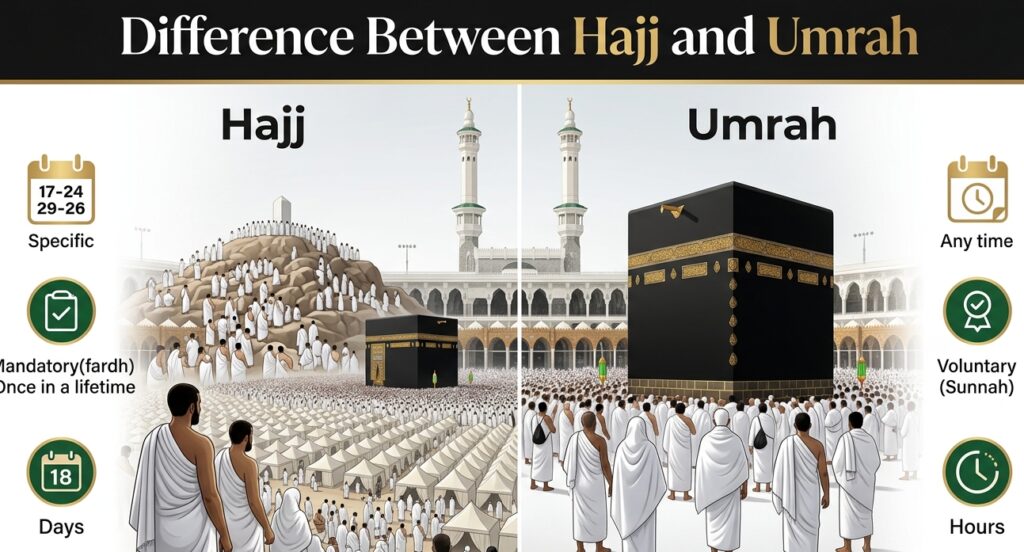
Difference Between Hajj and Umrah -Complete Comparison | AlNomadi
Many people want to know the difference between Hajj and Umrah, and it has a big part to play within Islam, and people making a journey there should really take it into account. At AlNomadi Tourism, we often help pilgrims understand these important differences before planning their journey. The biggest similarity where most people seem to have confusion is that both of the above require a journey to Makkah, with specific sacred rituals and high religious importance attached to the journey. But despite this, their regulations and times and general importance within the religion is completely different, hence making the information of the upcoming trip a vital one to know. In the following, you may also look at the guides, and Hajj, Umrah, Umrah Packages, and begin to plan for the trip ahead. What is Hajj? Hajj is the last pillar of Islam. Every muslim is to make Hajj if they are physically able and they have the money to do so. This Hajj takes place on the month of Dhul Hijja in the holy city of Makkah. All such pilgrims coming to this city dress in special attire which is known as Ihram. Every pilgrim coming to this city dresses up in one particular dress called Ihram. From this type of attire, we come to realize that there is no discrimination between man and woman in front of God. Hajj is not just a journey. It is a full purification ceremony which involves some major rituals such as Tawaf, Sa’i, standing in Arafat, camping in Muzdalifah, and sacrificing animals. One may therefore conclude that according to various scholars, Hajj is an initiation of new life leading to the total purification of all sins as if a newborn baby. What is Umrah? In relation to what Umrah is in Islam, Umrah can be regarded as a voluntary pilgrimage to Makkah that includes both spiritual gains and forgiveness. Umrah is a voluntary practice, whereby pilgrimage to Makkah is made at any time of the year other than during Hajj. It is a relatively easier act compared to Hajj. For complete details, kindly check out our Umrah guide and our Umrah step-by-step guide. There are four basic acts involved in Umrah which include: Although it is not mandatory, it comes with great benefit and leniency for Muslims. Difference Between Hajj and Umrah The difference between hajj and umrah is well understood through direct comparison of the two. They look alike but differ in many ways. Comparison Table Feature Hajj Umrah Islamic Status Fard (Mandatory) Sunnah (Voluntary) Timing Fixed days in Dhul-Hijjah Anytime in the year Duration 5–6 days Few hours to 1 day Rituals Complex and detailed Simple and short Crowds Extremely large Moderate Cost High Flexible Frequency Once in lifetime Multiple times allowed Physical strength, patience, and financial stability are some of the requirements of Hajj, but Umrah is relatively easy compared to Hajj. The Importance of Hajj in Islam Hajj is a religious commandment directly from Allah as stipulated in the Holy Quran. This is not just an obligatory act of Muslims that they have the freedom to neglect. While participating in Hajj, Muslims regardless of where they are in the world meet up at one place and become united through wearing of similar clothing and taking similar actions regardless of their social standing. The lessons that can be learned through Hajj include: Hajj is commonly known as a life-altering experience of a lifetime. Importance of Umrah in Islam Umrah is an important act of worship which provides spiritual peace and forgiveness. While this is not a must, it is greatly recommended in Islam religion. The Prophet Muhammad (PBUH) recommends that Muslims should do Umrah owing to its cleansing from sins and building of faith. Unlike Hajj pilgrimage, Umrah can take place all year round for those who: How to Perform Hajj Step by Step In case you want to know about the procedure of performing Umrah, it is very easy and simple as well, including some basic steps like Ihram, Tawaf, Sa’i, and finally cutting your hair. The pilgrimage of Hajj takes place according to a definite procedure in which each and every step carries huge importance. Each and every step of it is based on the Sunnah of both Prophet Ibrahim (AS) and Prophet Muhammad (PBUH) 1. Entering Ihram The pilgrims start the process by putting themselves in a state of Ihram.For the males, it is to wear two pieces of cloth while the females wear any clothes that cover all the body parts. They should declare their intention for Hajj and Talbiyah before this phase. This phase signifies, sanctity, equality, humility. Regardless of social class, men are treated the same by God. 2. Tawaf al Qudum: Pilgrims are walking toward the Kaaba and performing Tawaf al-Qudum that the pilgrims go around the Kaaba seven times from right to left. It is in this phase that pilgrims are making prayers to God. Shows the worship in unity with other Muslims as one community. 3. Sa’i between Safa and Marwah In this phase Muslims are walking seven times between these two hills in remembrance of Hajar’s (AS) struggle for water for baby Ismail (AS). The phase of developing patience, dependence on Allah and fortitude. 4. Arafat Day The Day of Arafat is considered to be the peak of Hajj. On this day, all Muslims are gathered near Mount Arafat where they are spending a whole day praying. It is believed that all prayers made on this particular day get easily accepted by Allah and all sins get forgiven. For this reason, many believe that this day is one of the most important days in one’s life. 5. Muzdalifah At dusk pilgrims head for Muzdalifah, pray at sunset and night prayers and stay there for a night, gathering pebbles in preparation for the upcoming ritual. This ritual teaches Muslims to rely solely on Allah and to live in poor conditions. 6. Rami (Stoning of the Pillars) During this