
Umrah packages

Umrah in Islam
Umrah in Islam, Umrah packages

What is Umrah in Islam? Meaning, Pillars & Significance | AlNomadi Tourism

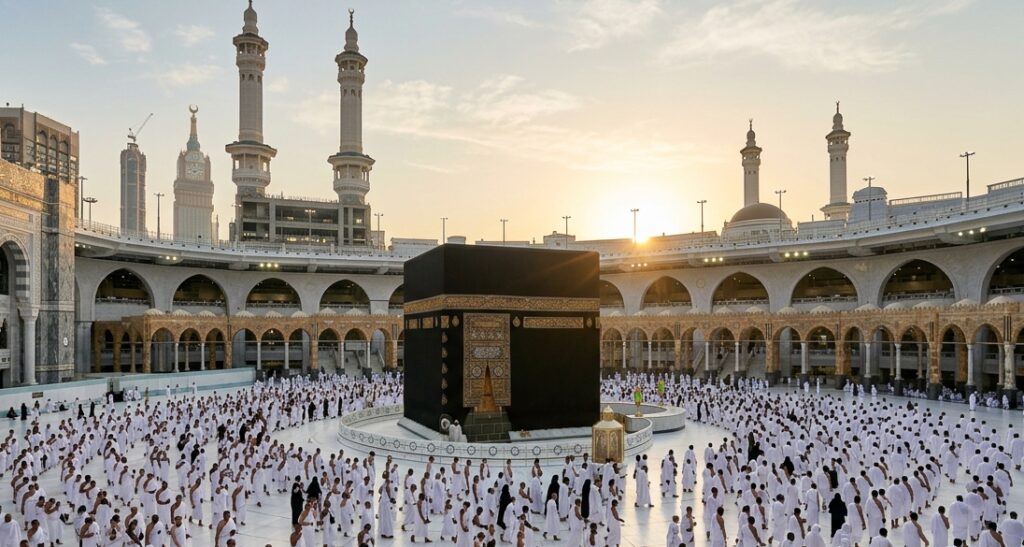
Millions of Muslims all over the world undertake the journey to Makkah every year, for one sole reason Umrah. At AlNomadi Tourism, we often see how this sacred journey transforms lives through peace, reflection, and devotion. Of the many peaceful, emotional, and spiritually charged journeys in Islam, Umrah ranks highest. However many a novice has still not understood and asked the following: “What is Umrah in English?”. In layman’s terms, Umrah is an optional pilgrimage to Makkah and involves undertaking specific rituals with a devotion, dedication and much love of Allah. Unlike everyday traveling, each stage of an Umrah pilgrimage carries with it a meaning and purpose and reward of spirituality. It isn’t just a journey of the body; rather it’s a journey of the soul, and Muslims return lighter, focused and refreshed spiritually. What Does Umrah Mean in English? “Umrah” is English for minor pilgrimage. Traveling to the city of Makkah is going for pilgrimage to the holy city and performing prayers to the holiest mosque of Islam Masjid al Haram. Hence when anyone searches for what is Umrah in English then it is to clarify that it means that Umrah is the Islamic non compulsory holy pilgrimage to Makkah to take part in the acts of worship with a pure heart so that sins are forgiven, so that one may get rewarded and blessed with Allah’s approval and that may help achieve spiritual enlightenment. Umrah isn’t some type of travel, rather it entirely works on ‘niyyah’, worship and compliance with Allah.  A Spiritual Journey That Changes Lives Umrah is not merely a religious obligation, but it’s a highly spiritual feeling. Muslims often claim that it’s a feeling where the heart reaches contentment and tranquility. One of the aspects that is really touching in Umrah is the equality that is maintained between the Muslims. When a person gets into the state ofIhram, everyone gets to wear simple white clothing. No extravagance, no class-distinction, no distinction between the poor and rich. All stand before Allah as the same. Why Muslims Perform Umrah: The Prophet Muhammad (PBUH) encouraged Umrah because it removes sins and increases spiritual reward when performed sincerely. Many believers describe it as a “reset for the soul.” The 4 Pillars of Umrah Umrah is a journey composed of 4 obligatory parts: 1. Ihram: Entering the state of sanctity Ihram is the entry into the state of pilgrimage. Ihram is not merely a form of dress it is a spiritual and disciplinarian state. The male pilgrims have to wear 2 white unstitched cloths while female pilgrims wear the Islamic dressing which properly covers them. When performing Ihram: no pilgrims is allowed to: Spiritual meaning of Ihram: Ihram has taught man humility and equality and entire surrender to God. It proves to man that before God, all human beings are equal. 2. Tawaf (Circling the Kaaba) Tawaf is the act of walking around the Kaaba seven times in a counter-clockwise direction. Kaaba is in Masjid al-Haram. This means millions of Muslims throughout history and everywhere in this universe in one united front before God, walking around one center. What Tawaf Represents: The realm of emotions: Tawaf is often the most emotional aspect of Umrah. It is a time where people weep as they supplicate to Allah, because they feel closest to him at that particular point of time.  3. Sa’i(Walking between Safa and Marwah) Sa’i is the practice of walking between two small hills, Safa and Marwah, seven times. This is when people ask: “What is sai in Umrah?”. This is where we see the struggle Hajar (AS) went through to find water for her child Ismail (AS) while running between the two hills, and how Allah blessed her in her efforts with Zam Zam water.  Lessons learned from Sa’i: 4. Halq or Taqsir (Hair Cutting) The final pillar is Halq or Taqsir. Meaning of This Step: It represents the completion of Umrah and spiritual renewal. The pilgrim leaves behind past sins and begins a fresh spiritual life. It is a symbol of: To go through a comprehensive practical guide, please look at our detailed step-by-step Umrah procedure guide which covers each step of Umrah right from Ihram to Halq. Where is Umrah Performed? Umrah is only performed in the holy city of Makkah in Saudi Arabia. Location / Area Purpose in Umrah Description Masjid al-Haram (Kaaba and surrounding area) Tawaf (circling the Kaaba) The holiest mosque in Islam where pilgrims perform Tawaf around the Kaaba. Safa and Marwah hills Sa’i ritual The two hills where pilgrims walk back and forth seven times, remembering Hazrat Hajar’s (AS) struggle. Miqat boundaries Entering Ihram Designated stations where pilgrims must enter the state of Ihram before proceeding to Makkah. It’s a holy site visited by millions of Muslims annually and one of the most holy sites on Earth.  When Can You Perform Umrah? Perhaps one of the most beautiful aspects of Umrah is the lack of restrictions, in terms of timing. You can carry out Umrah: Best Times for Umrah: This flexibility allows Muslims from all backgrounds to plan their journey easily. Is Umrah Fard or Sunnah? Most of the scholars believe that Umrah is Sunnah (recommended) rather than Fard (obligatory). Meaning: It is not obligatory like Hajj It is, however , a Sunnah and is recommended. It has tremendous rewards Most of the Muslims try to perform Umrah once in their lifetime for spiritual gains. The Significance of Umrah in a Muslim’s Life Umrah is far more than simply a spiritual act-it’s a profoundly spiritual experience. Benefits of the pilgrimage include: The vast majority of pilgrims will feel and look transformed when they leave. Many readers also wish to know the difference between the Hajj and the Umrah, therefore we list the main differences in religious and practical terms. Why Muslims throughout the world observe Umrah Muslims carry out Umrah with a multitude of purposes and with varied feelings and sentiments: Each individual journey is however different while the central theme
Difference Between Hajj and Umrah
Blog, Difference Between Umrah and Hajj, Umrah packages

Difference Between Hajj and Umrah -Complete Comparison | AlNomadi

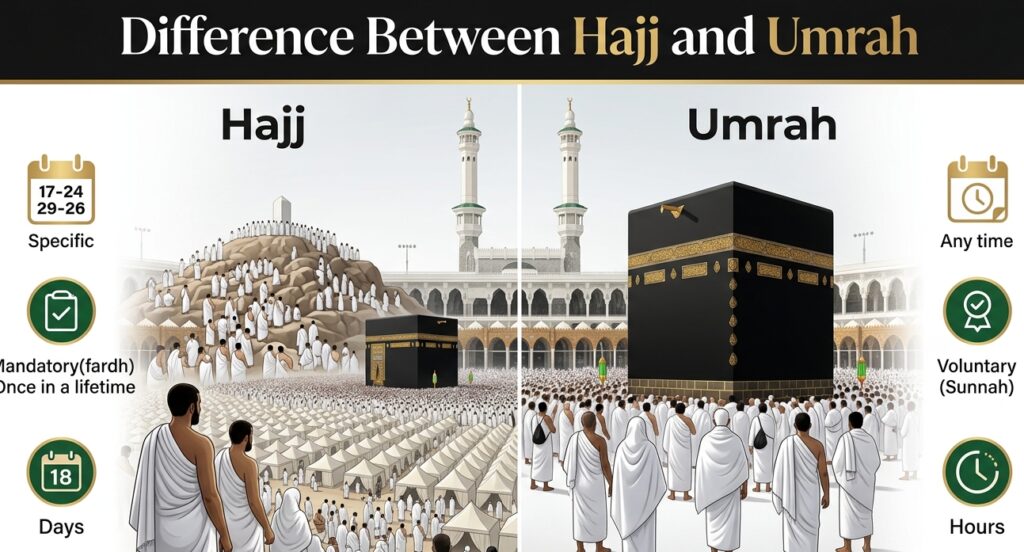
Many people want to know the difference between Hajj and Umrah, and it has a big part to play within Islam, and people making a journey there should really take it into account. At AlNomadi Tourism, we often help pilgrims understand these important differences before planning their journey. The biggest similarity where most people seem to have confusion is that both of the above require a journey to Makkah, with specific sacred rituals and high religious importance attached to the journey. But despite this, their regulations and times and general importance within the religion is completely different, hence making the information of the upcoming trip a vital one to know. In the following, you may also look at the guides, and Hajj, Umrah, Umrah Packages, and begin to plan for the trip ahead. What is Hajj? Hajj is the last pillar of Islam. Every muslim is to make Hajj if they are physically able and they have the money to do so. This Hajj takes place on the month of Dhul Hijja in the holy city of Makkah.  All such pilgrims coming to this city dress in special attire which is known as Ihram. Every pilgrim coming to this city dresses up in one particular dress called Ihram. From this type of attire, we come to realize that there is no discrimination between man and woman in front of God. Hajj is not just a journey. It is a full purification ceremony which involves some major rituals such as Tawaf, Sa’i, standing in Arafat, camping in Muzdalifah, and sacrificing animals. One may therefore conclude that according to various scholars, Hajj is an initiation of new life leading to the total purification of all sins as if a newborn baby. What is Umrah? In relation to what Umrah is in Islam, Umrah can be regarded as a voluntary pilgrimage to Makkah that includes both spiritual gains and forgiveness. Umrah is a voluntary practice, whereby pilgrimage to Makkah is made at any time of the year other than during Hajj. It is a relatively easier act compared to Hajj. For complete details, kindly check out our Umrah guide and our Umrah step-by-step guide. There are four basic acts involved in Umrah which include: Although it is not mandatory, it comes with great benefit and leniency for Muslims. Difference Between Hajj and Umrah The difference between hajj and umrah is well understood through direct comparison of the two. They look alike but differ in many ways. Comparison Table Feature Hajj Umrah Islamic Status Fard (Mandatory) Sunnah (Voluntary) Timing Fixed days in Dhul-Hijjah Anytime in the year Duration 5–6 days Few hours to 1 day Rituals Complex and detailed Simple and short Crowds Extremely large Moderate Cost High Flexible Frequency Once in lifetime Multiple times allowed Physical strength, patience, and financial stability are some of the requirements of Hajj, but Umrah is relatively easy compared to Hajj. The Importance of Hajj in Islam Hajj is a religious commandment directly from Allah as stipulated in the Holy Quran. This is not just an obligatory act of Muslims that they have the freedom to neglect. While participating in Hajj, Muslims regardless of where they are in the world meet up at one place and become united through wearing of similar clothing and taking similar actions regardless of their social standing. The lessons that can be learned through Hajj include: Hajj is commonly known as a life-altering experience of a lifetime. Importance of Umrah in Islam Umrah is an important act of worship which provides spiritual peace and forgiveness. While this is not a must, it is greatly recommended in Islam religion. The Prophet Muhammad (PBUH) recommends that Muslims should do Umrah owing to its cleansing from sins and building of faith. Unlike Hajj pilgrimage, Umrah can take place all year round for those who: How to Perform Hajj Step by Step In case you want to know about the procedure of performing Umrah, it is very easy and simple as well, including some basic steps like Ihram, Tawaf, Sa’i, and finally cutting your hair. The pilgrimage of Hajj takes place according to a definite procedure in which each and every step carries huge importance. Each and every step of it is based on the Sunnah of both Prophet Ibrahim (AS) and Prophet Muhammad (PBUH) 1. Entering Ihram The pilgrims start the process by putting themselves in a state of Ihram.For the males, it is to wear two pieces of cloth while the females wear any clothes that cover all the body parts. They should declare their intention for Hajj and Talbiyah before this phase. This phase signifies, sanctity, equality, humility. Regardless of social class, men are treated the same by God. 2. Tawaf al Qudum: Pilgrims are walking toward the Kaaba and performing Tawaf al-Qudum that the pilgrims go around the Kaaba seven times from right to left. It is in this phase that pilgrims are making prayers to God. Shows the worship in unity with other Muslims as one community. 3. Sa’i between Safa and Marwah In this phase Muslims are walking seven times between these two hills in remembrance of Hajar’s (AS) struggle for water for baby Ismail (AS). The phase of developing patience, dependence on Allah and fortitude. 4. Arafat Day The Day of Arafat is considered to be the peak of Hajj.   On this day, all Muslims are gathered near Mount Arafat where they are spending a whole day praying. It is believed that all prayers made on this particular day get easily accepted by Allah and all sins get forgiven. For this reason, many believe that this day is one of the most important days in one’s life. 5. Muzdalifah At dusk pilgrims head for Muzdalifah, pray at sunset and night prayers and stay there for a night, gathering pebbles in preparation for the upcoming ritual. This ritual teaches Muslims to rely solely on Allah and to live in poor conditions. 6. Rami (Stoning of the Pillars) During this

Scroll to Top

You Can Contact Us If You Have Any Query